Most pet gates are designed with dogs in mind. Put one across a doorway and a dog stays put. A cat looks at it, sits for a moment, then hops over.
That doesn't mean gates are useless in a cat home. You just need to be clear about what you want the gate to do, because the right gate for keeping a cat out of a room is different from the right gate for letting the cat through while the dog stays behind. Every gate in our pet gates range is made by PawHut, and the examples below come from those listings.
What do you want the gate to do?
|
Job |
What to look for |
Example from our range |
|---|---|---|
|
Let the cat through, keep the dog back |
A gate with a built-in cat door |
PawHut gate with cat door, 74 to 80cm wide, auto-close |
|
Make it harder for the cat to get past |
An extra tall gate |
PawHut tall gate with cat door, 106cm high, 76 to 104cm wide |
|
Give a new cat or kitten a safe room |
A tall gate, with the cat door kept closed or a crate for small kittens |
PawHut extra tall gates, 74 to 101cm wide |
Will a cat jump over a pet gate?
Most will, if they want to. A standard pet gate is built to stop a dog walking through, not to stop an animal that can jump several times its own height. Our own collection page says as much: many cats can jump or climb a standard gate.
A taller gate makes it harder. The PawHut tall gate stands 106cm high, which puts it well above most standard pet gates. A determined, athletic cat may still clear it, so treat height as a deterrent rather than a guarantee.
If you need a cat kept out completely, such as from a room with a new baby or a fragile hobby, a closed door is still the only sure option.
How does a gate with a cat door work?
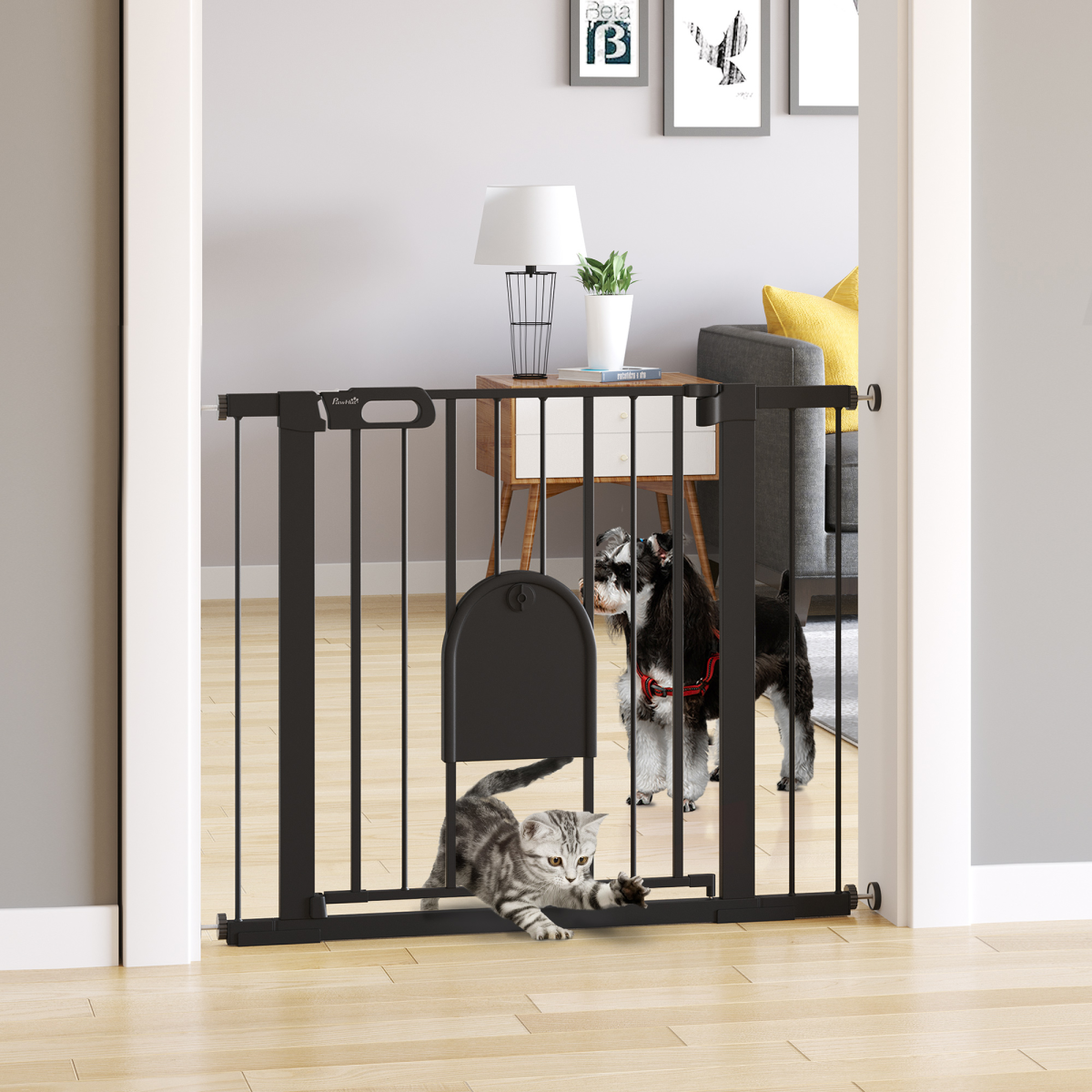
A cat door gate has a small opening built into the bottom of the panel, sized for a cat to walk through. The main gate stays shut, so the dog stays on one side while the cat comes and goes.
That's the most popular use for a cat gate in a home with both pets. It lets you set up a dog-free zone with the cat's food, water and litter tray, so the cat can eat and use the tray in peace.
Before you buy, check two things:
- The size of your dog. A small dog or a puppy may fit through a cat-sized opening. If your dog is close to your cat's size, a cat door gate won't keep them apart.
- Whether the cat door can be closed. Being able to shut it gives you a standard gate for times when you want everyone kept separate.
We stock several PawHut gates with cat doors, in widths from 74 to 80cm up to 76 to 104cm, with auto-close main doors and double locking on some models. Check each listing for the size of the cat door itself.
Can I use a cat gate when introducing a cat and a dog?
Yes, and it's one of the most useful jobs a gate does. A gate lets the two see and smell each other without being able to reach each other, so you can take introductions slowly.
The Scottish SPCA's guide to introducing dogs and cats recommends getting a gate before the second animal arrives, and notes that gates come in shorter and taller versions and with cat flaps. It also points out that a kitten may be able to slip through a gate's bars, so for kittens use a crate, or add extra mesh to the gate.
Which cat gate suits a doorway?
Most cat gates go in doorways, which makes a pressure-fit gate the natural choice. It holds by tension against the door frame, so there's no drilling and it comes out cleanly when you no longer need it.
Measure the doorway at the height the gate will sit and check it falls inside the gate's stated range, such as 74 to 80cm or 75 to 103cm. Our guide on how to measure for a pet stair gate covers the details, and the same method works for doorways.
For wide openings, retractable mesh gates in our range extend to 115cm or 140cm and roll away when not in use.
Can I use a cat gate on the stairs?
You can, and it's a common way to keep the upstairs cat-only. Fit position matters, though. At the top of the stairs, a screw-fit gate is the safer choice because it can't be pushed loose. Pressure-fit gates are fine at the bottom.
Our post on pressure-fit versus screw-fit pet gates explains the difference in more detail.
What about freestanding barriers?
Freestanding wooden barriers stand on their own support feet with no fixing at all, and fold away when you're done. They're handy for a dog in an open-plan room. For cats, they're the least effective option: there's no frame to stop a cat going round the end, and most are low enough to jump.
Cat gate checklist
|
Check |
Why |
|---|---|
|
What the gate is for |
Cat through and dog back, or keeping the cat out |
|
Gate height |
Taller is harder to jump; 106cm on our tallest cat gate |
|
Cat door size |
Make sure your dog can't fit through it too |
|
Doorway width |
Must fall inside the gate's stated range |
|
Fitting |
Pressure-fit for doorways, screw-fit at the top of stairs |
|
Kittens |
May fit through bars; use a crate or add mesh |