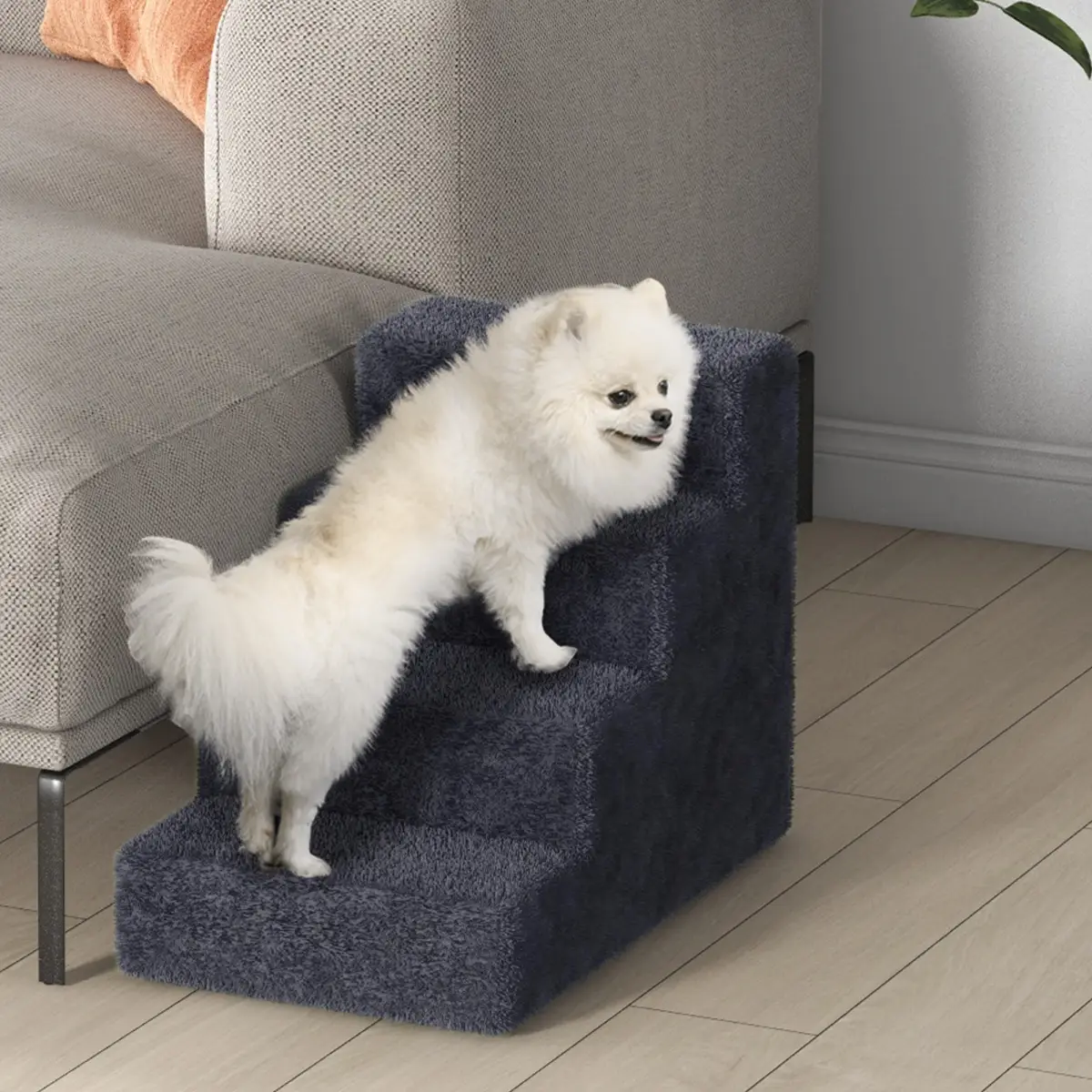
If your dog sleeps on your bed or naps on the sofa, they're jumping down from that height several times a day. Dog steps give them a way up and down without the leap, and they save you lifting a small or sleepy dog every evening.
The trouble is that pet steps vary far more than they look. Heights, step sizes and weight limits differ a lot from one design to the next. This guide works through the three numbers that matter, then the main types. Most of our dog steps are made by PawHut, so the examples come from their listings.
The three numbers to check
- The height of your bed or sofa, measured from the floor to the top of the mattress or seat cushion.
- The height of each step, which is the total height divided by the number of steps.
- The weight limit, which ranges from 4.5kg to 25kg across our range.
How tall should dog steps be?
The top step should sit level with, or just below, the surface your dog is climbing onto. If it's much lower, your dog still has to jump the last bit, which defeats the point.
Measure your sofa from the floor to the top of the seat cushion, and your bed to the top of the mattress. Do it with the bedding on, as a thick duvet or topper adds height. Then compare that figure with the total height on the product page.
How many steps does my dog need?
More steps means a smaller climb for each one. Divide the total height by the number of steps and you get the height of each step, which is what your dog actually has to manage.
|
Example from our range |
Total height |
Steps |
Height per step |
|---|---|---|---|
|
PawHut portable steps with plush cover |
44cm |
4 |
11cm |
|
PawHut 3-step portable steps, 46 x 35 x 35cm |
35cm |
3 |
about 12cm |
|
PawHut wooden 4-step with washable cushions |
54cm |
4 |
about 13.5cm |
|
PawHut 3-step for small dogs and cats with scratching posts |
60cm |
3 |
20cm |
For small breeds, short-legged dogs and puppies, look for a lower height per step. A long-legged dog can manage a taller step, but a dachshund or a toy breed will find 20cm hard work.
If your dog has mobility problems or is recovering from an injury, ask your vet what type of access suits them before you buy.
What weight can dog steps hold?
This is the number people miss. Some of our cat-sized steps have a 4.5kg weight limit, while the PawHut 10-step ramp is rated to 25kg. Most other listings sit in between or don't state a figure.
Check the listing for the weight limit and pick one comfortably above your dog's weight. If a listing doesn't say, treat it as a small-dog or cat product until you've confirmed otherwise.
Which type of dog steps should I choose?
- Foam steps with a plush cover. Light enough to move from the bed to the sofa, soft underfoot and quiet. The covers on many PawHut designs are washable. They suit small dogs and cats.
- Wooden steps with cushions or carpet. Sturdier and less likely to shift. The PawHut wooden 4-step measures 54 x 40 x 59cm (H x W x D) with washable cushions, and some 3-step wooden designs have storage built into the steps for toys, treats or a lead.
- Foldable steps. Non-slip treads on a frame that folds flat, so they can go behind the sofa or into a cupboard when guests come round.
- Steps with scratching posts. Built for cats and small dogs, with sisal posts and platforms. Handy in a home with both.
- Adjustable steps and ramps. Some PawHut designs adjust in height or convert to a ramp, which helps if you want to use them on more than one piece of furniture.
Dog steps or a ramp?
Steps take up less floor space for the height they reach. A ramp gives a continuous slope with no individual steps to climb, but needs a longer run to reach the same height.
For beds and sofas in a normal-sized room, steps are the practical choice. Ramps come into their own at car boots and very high beds, where the length is easier to accommodate.
What about getting a dog into the car?
Our PawHut 10-step dog car ramps have anti-slip treads and a 25kg weight limit, and they work for car boots and high beds. They come in brown, grey and black.
Once your dog is in, the Highway Code says animals in a vehicle should be suitably restrained so they can't distract you or be hurt if you stop quickly. A crate or dog guard in the boot does that job.
Where should dog steps go?
Push the steps right up against the bed or sofa so there's no gap at the top. On wooden or tiled floors, check the base has non-slip feet or grip, or stand the steps on a rug.
Give your dog a few days to get used to them. A treat on each step works well for most dogs.
Dog steps at a glance
|
Check |
What to look for |
|---|---|
|
Total height |
Level with the top of the bed or seat cushion |
|
Height per step |
Lower for small, short-legged or young dogs |
|
Weight limit |
Comfortably above your dog's weight; 4.5kg to 25kg across our range |
|
Type |
Foam for light use and moving round, wooden for stability, ramp for the car |
|
Floor |
Non-slip feet or a rug on hard floors |