Most pet gates that get sent back were never faulty. They just didn't fit. Someone measured the door, ordered a gate that said 75 to 103cm, and then found the tension bars wouldn't grip because the skirting board stole two centimetres at floor level. It's a five minute job to get this right and it saves a lot of annoyance later.
Get a proper tape measure
A soft dressmaking tape will do at a push, but a retractable metal tape is better because it stays rigid across an opening. Measure in centimetres. Nearly every gate on the market states its range in centimetres, and converting from inches halfway through is how people end up ordering the wrong size.
Write the number down. Don't trust yourself to remember it while you scroll through a hundred listings.
Measure at three heights, not one
This is the bit people skip. Openings are rarely perfectly square, especially in older houses where the plaster has moved or the frame has been rehung at some point.
Measure across the gap at floor level, at roughly knee height, and at about a metre up. If all three numbers match, you've got a straightforward opening. If they don't, use the narrowest one when you're checking against a gate's stated range, and use the widest one when you're checking the gate won't be too short to reach.
The gap between those numbers matters too. A difference of a centimetre is normal. A difference of four or five centimetres means the walls are noticeably out of true, and a pressure fit gate may sit at a slight angle or grip on only two of its four pads.
Watch the skirting board
Skirting is the single most common culprit. A gate's lower tension bars often sit right at the height of the skirting, which means the effective width at that point is narrower than the width higher up.
Two options here. Some gates include small spacers or wall cups that sit above the skirting line, and some come with skirting board adaptors. Or you can pick a gate where the fixing points sit clear of it. Either way, take a separate measurement across the top of the skirting so you know what you're actually dealing with.
Chair rails, dado rails and picture rails cause the same problem further up.
What the stated range actually means
When a gate says 74 to 100cm, that is the full span it can cover including any extension panels supplied in the box. Read the description carefully, because some ranges only reach their maximum once you've fitted an extension.
Aim for the middle of the range where you can. A gate stretched to the absolute limit of its adjustment has less thread engaged and less margin if the wall isn't quite flat. A gate compressed to its minimum can be a squeeze to get in at all.
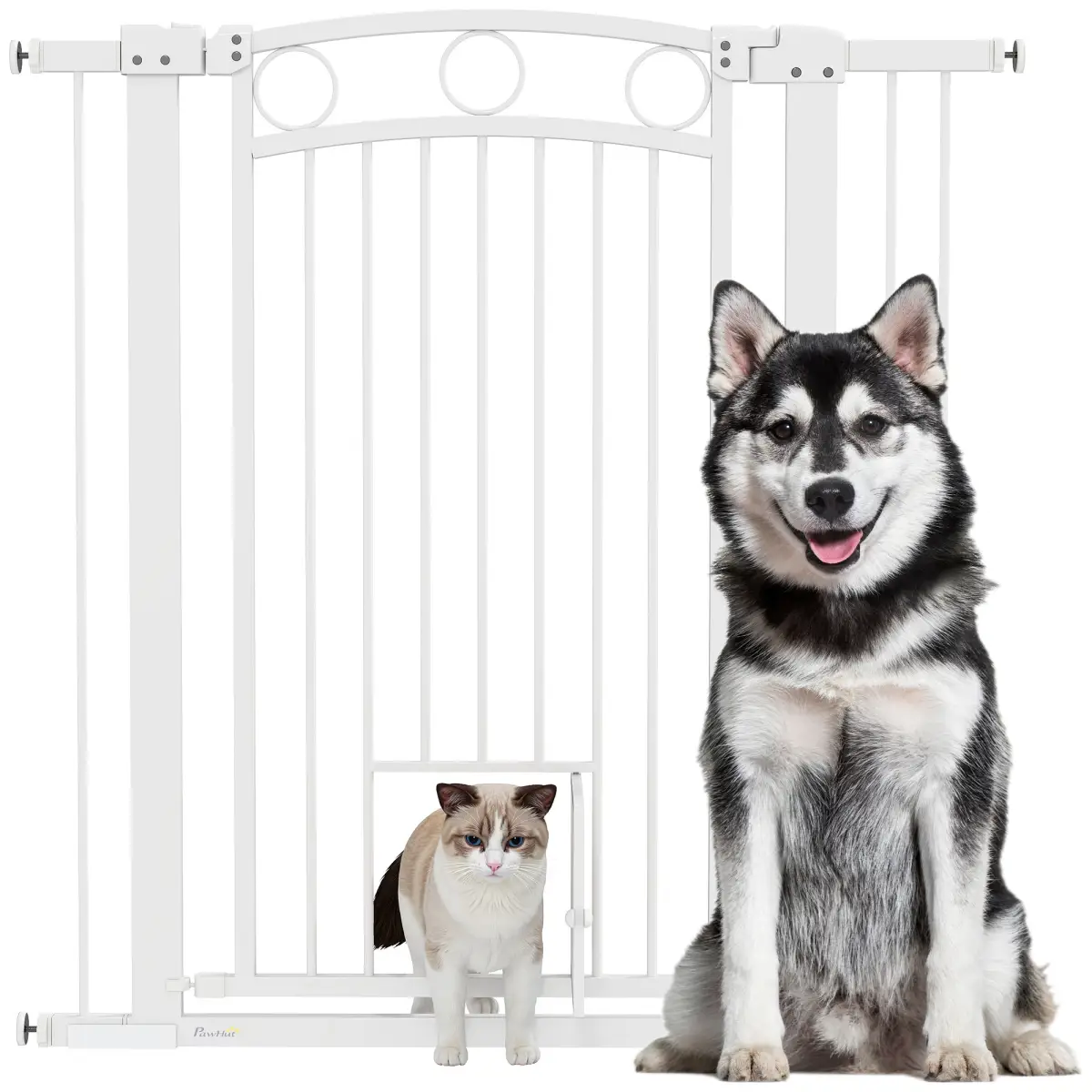
Across the range at Bossy Cat, the standard doorway sizes tend to cover somewhere between 74 and 103cm, with wider models reaching 115cm and retractable versions stretching to 140cm. The multi-panel freestanding barriers go much further, up to 432cm, but those work on a different principle and we'll come to those in a later post.
Height matters as much as width
Width gets all the attention. Height is what stops a determined dog going over the top.
Measure your dog standing on all fours, from the floor to the top of the shoulder. As a rough rule, a gate should be at least as tall as the dog's shoulder height plus about half again, and taller still if you've got a jumper. Collies, lurchers, whippets and springers will clear a low gate without much effort. A dachshund will not.
Extra tall gates around the 106cm mark exist for exactly this reason, and they're worth the extra few pounds if you've got an athletic dog.
Check what you're fixing to
Have a look at the surfaces on both sides of the opening before you order anything.
Solid plaster over brick is ideal for both pressure fit and screw fit. Plasterboard on its own will take a pressure fit gate fine but needs proper fixings if you're screwing into it. Tiled walls, glass panels and stair spindles all need thinking about, because a pressure pad has nothing flat to push against on a rounded spindle.
If one side of your opening is a banister rather than a wall, you'll need a gate that comes with a spindle adaptor kit, or you'll need to look at a freestanding option instead.
Doors, radiators and the things in the way
Stand in the opening and look at what's around it. A gate that swings open needs somewhere to swing to. If there's a radiator right beside the frame, or a door that opens inwards, or a coat hook at head height, that affects which way round you fit the gate.
Think about the direction of travel too. Anything at the top of a staircase should open away from the stairs, never over them.
Two measurements you'll be glad you took
Before you order, note down the width of the narrowest point and the depth of your skirting. That's genuinely all you need to filter a listing in about ten seconds.
Once you've got those, you can move on to the more interesting question, which is how the gate should attach to the wall in the first place. Pressure fit and screw fit behave very differently, and the right answer depends a lot on where the gate is going.
Browse the full range of pet gates and safety barriers, with free delivery to UK mainland addresses and dispatch within 3 to 5 working days. No hidden fees at checkout.