Most pet gates that get returned or abandoned in a cupboard weren't badly made. They were the wrong gate for the spot they went in, or the wrong height for the animal they were meant to stop.
So rather than starting with the gate, start with the room and the dog.
What is the gate actually stopping?
There are three jobs a pet gate does, and they need different products.
The first is safety. A puppy that hasn't learned stairs yet, or an older dog with dodgy back legs, needs a physical barrier that will not move.
The second is management. Keeping the dog out of the kitchen while dinner is being cooked, or off the good sofa in the front room. Nothing dangerous happens if the gate gets pushed, it's just an inconvenience.
The third is separation. A new cat settling into one room, or a puppy and a resident dog who need supervised introductions only.
Work out which of the three you're doing before looking at anything, because the answer changes what you buy.
The top of the stairs
This is the one place where the choice is not really a choice. Use a screw-fit gate.
A pressure-fit gate holds itself in place by tension against the frame. That's fine at floor level, but at the top of a staircase a gate that shifts under pressure is a genuine hazard, and pressure-fit gates also have a bottom bar to trip over. Screw-fit models mount into the wall or the newel post and stay put.
Our adjustable gates that come with extensions and four adjustable screws sit in this bracket, currently £50.99 in white and £52.99 in the other finish. They also take extension panels if the landing opening is wider than standard.
If you rent and can't drill, be honest with yourself about whether the stairs need blocking at the top at all. Blocking the bottom instead is often the safer compromise.
Doorways and the bottom of stairs
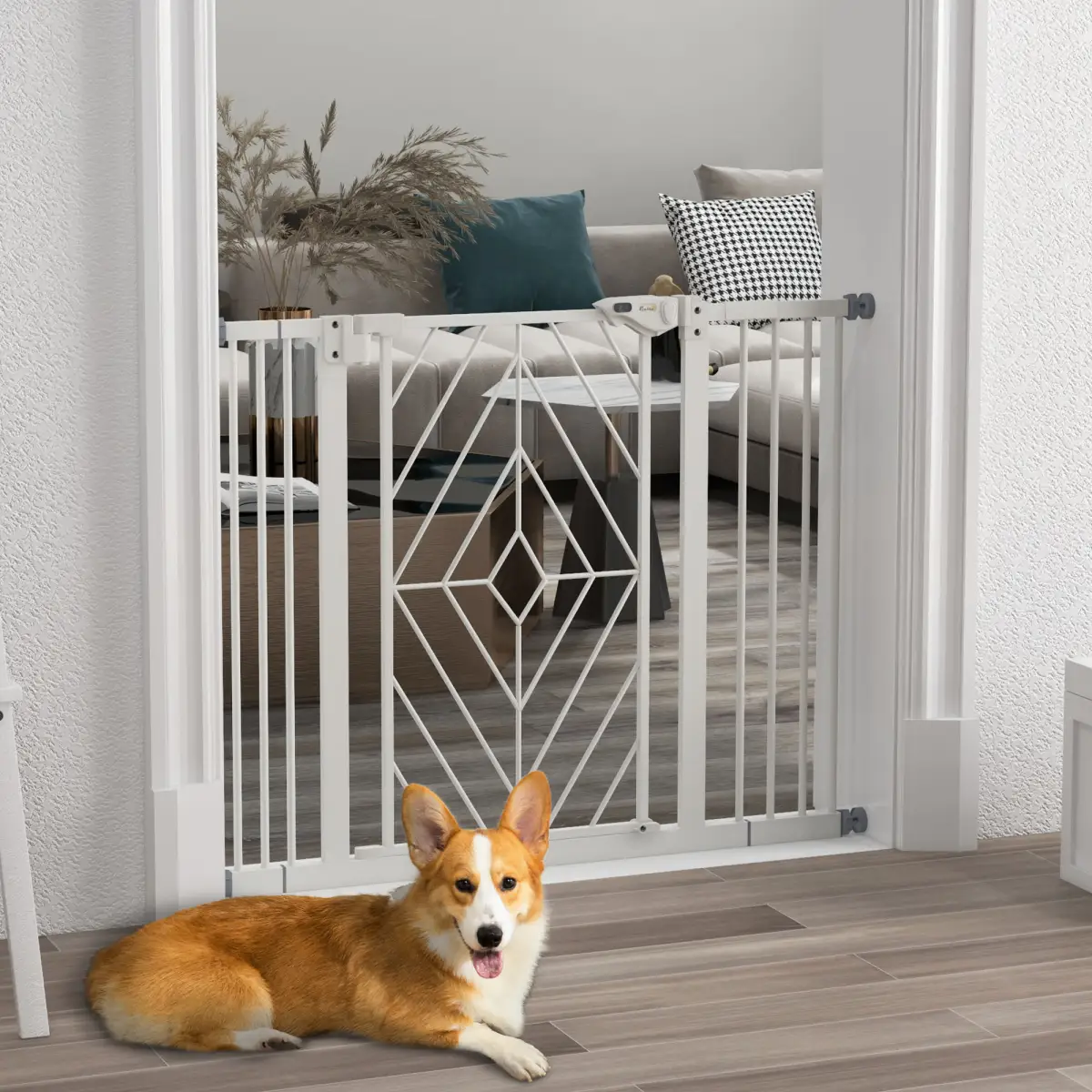
Here pressure-fit is fine and it's the easier option. No drilling, no filling holes when you move out, and you can take it down in seconds when you're carrying a hoover through.
The bulk of the range is built for this. Standard auto-close gates cover openings from around 74cm to 100cm, with prices running from about £35.99 to £54.99 depending on width, finish and features.
Two things worth paying extra for. An auto-close door swings shut behind you, which matters more than it sounds when you're carrying a laundry basket. And a double locking mechanism stops the clever dogs from nosing the latch open. Plenty of dogs work out a single catch within a fortnight.
Open-plan rooms and wide gaps
Modern houses with knocked-through kitchens are where fixed gates fall down, because there's often no frame to press against.
Freestanding panel barriers solve this. They stand on their own support feet, unfold to whatever shape the room needs, and fold flat for storage. The three-panel wooden versions are £48.99 in black and £50.99 in white, and they can be curved around a corner rather than sitting in a straight line.
For bigger areas, the five-panel playpen designs stretch to around 300cm and include a walk-through door, currently £71.99 in black and £75.99 in white. These are the ones to look at for penning off a puppy zone in a large room.
Bear in mind that freestanding barriers are a deterrent, not a wall. A determined 30kg dog will shift one. They're for management, not safety.
Height matters more than most people expect
This is the detail that gets missed.
A standard gate is roughly 75cm tall. That stops most dogs, but it will not stop a springer, a collie, a lurcher, or frankly any young dog that has decided the barrier is a challenge. Extra tall gates go up to around 106cm, and one of ours is exactly that at £61.99.
Cats are a separate problem. Most cats can clear a standard gate without breaking stride, and the ones that can't jump it will climb it. If the aim is to confine a cat, a normal pet gate is not the tool.
Two practical tests. Watch whether your dog jumps up at the back door when excited, and note roughly how high the paws land. And with a puppy, buy for the adult size, not the current one, because you'll otherwise be buying twice.
Multi-pet homes
Several gates in the range have a small cat door built into the bottom panel. The cat passes through, the dog stays where it is.
This is the single most useful feature for a household with both. It means the cat keeps access to its litter tray, food and escape routes upstairs while the dog is contained. The 74 to 80cm extra tall version is £48.99 and the wider 74 to 101cm model is £54.99.
Check the flap size against your cat before ordering. A large or long-haired cat may find a small opening awkward, and a cat that finds a route unpleasant will simply stop using it.
Measuring, briefly
Measure the opening at the exact height the gate will sit, not at floor level. Skirting boards, uneven Victorian plaster and radiator pipes all narrow the gap in ways that surprise people.
Then check your measurement sits comfortably inside the gate's stated range rather than right at the top of it. A gate at the very limit of its adjustment holds less firmly.
One last thing about training
A gate is a management tool. It stops the behaviour happening while you work on the behaviour itself.
Dogs that are left to bark and scrabble at a gate for hours tend to get worse, not better. Use the gate to prevent rehearsal of the habit, give the dog something to do on its side of it, and the gate becomes a help rather than a battleground.
What to spend
The full range runs from £29.99 to around £76. Under £45 gets you a retractable or standard pressure-fit gate. Between £45 and £62 covers extra tall models, cat door versions and screw-fit gates with extensions. Above that you're into multi-panel playpens.
Free delivery to UK mainland addresses, excluding Northern Ireland, on every order. Dispatch is 3 to 5 working days and there are no hidden fees at checkout. Change of mind returns are accepted, with the return postage covered by the customer.