Most people shopping for a drop leaf table focus on how small it gets. That's the wrong end of the problem. The folded size is rarely what causes trouble. What catches people out is the extended size, because that's when the table is actually in use and that's when the room either works or doesn't.
Here's how to work through it properly before you order.
Measure the space twice
You need two numbers for the spot where the table will live.
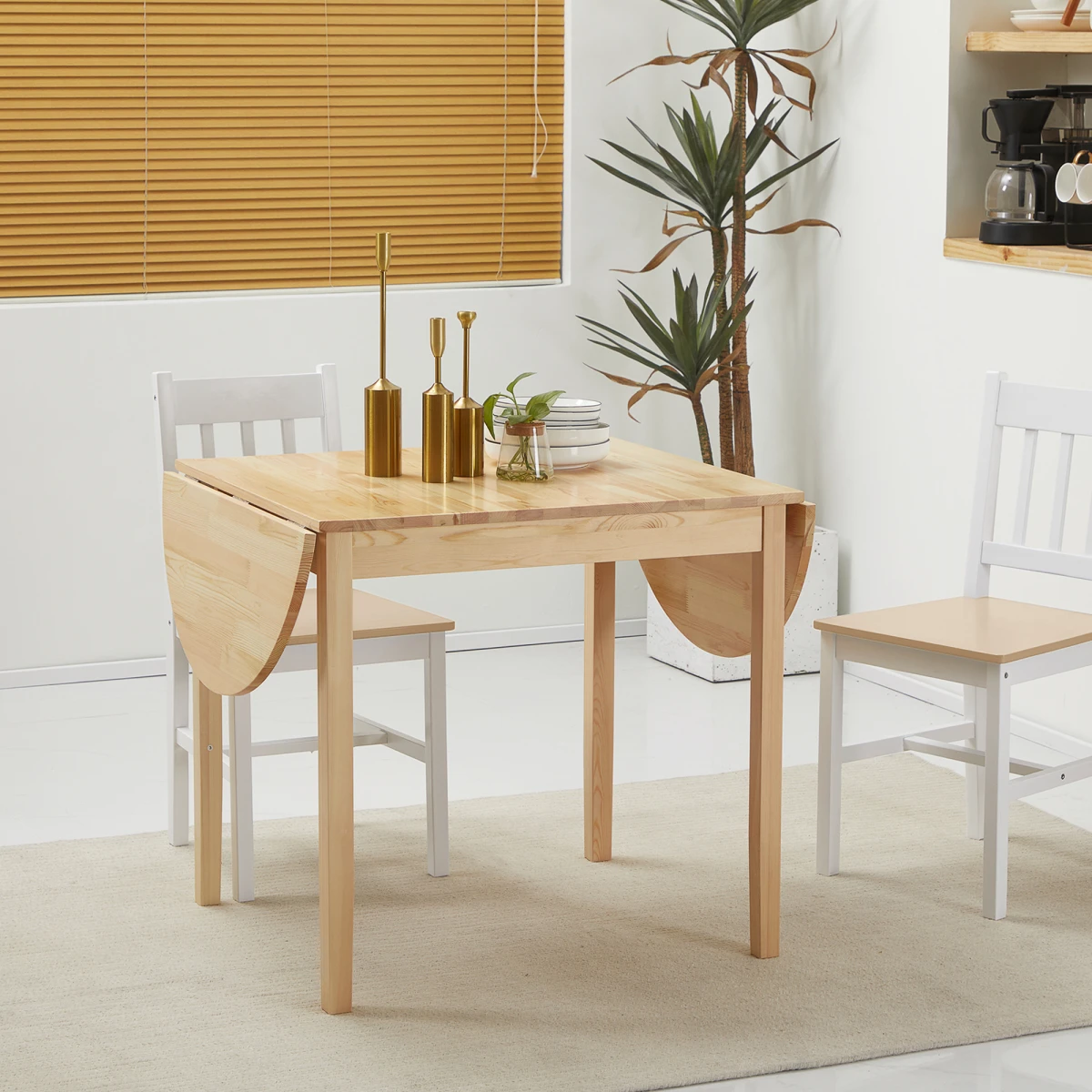
The first is the wall space it will occupy folded. Most drop leaf tables sit somewhere between 25cm and 45cm deep with both leaves down, which is roughly the depth of a console table. That's the easy measurement.
The second is the floor area you'll need with the leaves up. This is where the maths gets less forgiving. A table that opens to 120cm by 72cm, like the HOMCOM foldable model at £71.99, needs the 120 by 72, plus room for chairs, plus room for people to get past chairs.
Mark it out on the floor with masking tape before you buy anything. It takes five minutes and it tells you more than any product photo.
The clearance figures that matter
Allow 75cm behind each chair as an absolute minimum. That's just enough for someone to sit down and stand up without shuffling sideways.
If people need to walk past a seated diner, make it 100cm. Anything less and someone ends up doing that awkward sidestep with a plate in each hand every mealtime.
In a galley kitchen, you'll often find you can only meet the clearance on two sides. That's fine, and it's exactly why a table pushed against a wall with one leaf permanently down works so well. You seat two on the open side and lift the second leaf only when you need it.
Work out seating honestly
The rule of thumb is 60cm of table edge per person. Below that, elbows start colliding.
Run that against a real table. A 120cm long top gives you two comfortable places down each long side. Add the ends and you can push it to four, though the people on the ends will be tight. Manufacturer claims of "seats 2 to 4" usually mean two in comfort and four at a squeeze, which is honest enough as long as you know that going in.
If you regularly feed four or more, look at the larger end of the range. The HOMCOM pinewood expandable table at £124.99 is built for four to six and is the one to consider if Sunday lunch is a proper event rather than a rare one.
Check the height against your chairs
This is the mistake that generates the most returns, and it's completely avoidable.
Standard dining height in the UK is around 75cm. Bar and counter height tables run closer to 90cm or higher. Our folding bar table at £56.99 is one of the taller ones, and it needs stools, not dining chairs.
Measure from the floor to the top of your existing chair seats. You want roughly 28 to 30cm of gap between the seat and the underside of the table. Any less and your legs won't fit. Any more and you'll be eating with your chin near the plate.
If you're buying dining chairs at the same time, do it in that order: table first, then chairs to suit.
Wheels or fixed legs
Castors are genuinely useful in a small kitchen. You roll the table out for dinner and push it back against the wall afterwards, no lifting involved. Several of ours have them, including the mobile drop leaf table with shelves at £71.99 and the white folding desk version at £72.99.
The trade-off is a slight amount of give underfoot even with the brakes on. If you want something rock solid for daily heavy use, fixed legs are the safer choice. If your kitchen doubles as a walkway, wheels win.
Storage under the top is worth paying for
A number of models have drawers or open shelves beneath the tabletop. The grey wood table with drawers at £79.99 and the white version at £82.99 both do this.
In a small kitchen this matters more than it sounds. Placemats, cutlery and napkins living inside the table means one less cupboard needed and one less trip across the room when you're laying up. If your kitchen storage is already stretched, prioritise this feature over finish or colour.
Think about the second job
Drop leaf tables rarely do just one thing, and the good ones are bought with that in mind.
Fold one leaf and most of them become a workable desk. The teak and white mobile version at £67.99 is sold as a writing desk as much as a dining table. Others in the range work as a kitchen island, like the compact white oak model at £101.99, or as a craft surface, which is what the wide folding sewing table at £68.99 was designed for.
If the table needs to earn its keep in more than one role, choose on the second use rather than the first. The dining part is straightforward. The desk or island part has specific requirements around height and legroom.
Two last checks
Measure your doorway and any turn in the hallway. These arrive flat packed, so the box is the constraint, not the assembled table, but tight Victorian stairwells still catch people out.
And set aside about an hour for assembly. The leaf hinges need to be aligned carefully. Rush that bit and the leaves will never sit flush.
What to spend
Our drop leaf range runs from £53.99 to £143.99, and every one of the 18 is HOMCOM. Under £70 gets you a compact two to four seater in engineered wood. Between £70 and £100 adds drawers, shelves or wheels. Above £100 you're into the larger pinewood tables and kitchen island designs.
Free delivery to UK mainland addresses, excluding Northern Ireland, on every order. Dispatch takes 3 to 5 working days and there are no hidden fees at checkout. Change of mind returns are accepted, though the return postage is covered by the customer.