Walk into any decent office building, hospital or supermarket on a wet Tuesday and you will cross three different mats before you reach the main floor. Nobody notices them, which is rather the point. That layout is not decoration. It is a standard approach used by facilities managers because a single mat, however good, cannot do the whole job on its own.
Most British homes have one mat, or a folded towel, or nothing. Then the hallway carpet turns grey in the first metre and stays that way.
The three zone method is easy enough to copy at home, and it does not need a grand porch or a boot room to work. It just needs the right mat in the right place.
Why one mat struggles
The problem is that dirt arrives in two forms, and they need different treatment.
The first is solid. Grit, sand, dried mud, small stones from the pavement, salt granules in winter. That material sits in the tread of a shoe and needs scraping out. A coarse surface does this well.
The second is liquid. Rain, puddle water, wet grass, slush. That needs absorbing, and it needs somewhere to go. A coarse scraper surface pushes water around rather than holding it.
Ask one mat to do both and it does each one at about half strength. Worse, once the mat is saturated it stops absorbing entirely and starts acting as a wet sponge that redistributes water onto the floor behind it. Anyone who has stepped off a soaked doormat onto laminate knows exactly how that feels.
Zone one: outside the door
This is your scraper. Its only job is to knock the loose solid material off before anyone crosses the threshold.
A coir or rubber mat on the step or path does this. It does not need to be large. It does not need to be absorbent, and it should not be a barrier mat, because the barrier mats in our range are made for indoor use and will stay damp if left out in the rain.
If you have no covered step and nowhere sensible for an outside mat, skip this zone and give zone two more length instead. That is the trade-off, and it is a reasonable one.
Zone two: the barrier mat inside the door
This is where the real work happens, and it is the mat most households get wrong by buying something far too small.
The measure that matters is not width, it is length in the direction people walk. A person needs to take at least two full steps on the mat for it to remove a meaningful share of what is left on their shoes. One step catches a fraction. Three or four catches most of it.
Two adult strides is roughly 150cm. That number surprises people, because the classic 40 x 60cm doormat gives you about half a step.
Looking at what we actually stock, that points most homes towards the longer sizes:
- 90 x 150cm at £18.99 is the sensible minimum for a front door that gets daily use
- 90 x 200cm at £23.99 suits a family entrance or a back door onto a garden
- 120 x 180cm at £26.99 works well for wide double doors or a square entrance hall
- 80 x 300cm at £29.99 is a runner for long hallways and shared entrances
Smaller options are there for a reason. 40 x 60cm at £8.99 is fine for a rarely used side door, and 60 x 90cm at £11.99 covers a flat entrance where floor space is genuinely tight. Both are still a large improvement on bare flooring. They are just not going to strip a pair of muddy boots.
The one physical constraint to check before ordering is door clearance. Measure the gap under the door with it closed, then check the mat depth. If the door catches, either move the mat back from the threshold or drop to a smaller size.
Zone three: the run-off
The third zone is the stretch of floor immediately past the mat, where whatever survived the first two zones ends up.
In a commercial building this is a fitted runner. At home it can be as simple as a second, cheaper mat placed a metre or so beyond the main one, or a washable rug over the section of hallway carpet that always looks worst.
If budget only stretches to two mats, buy one long mat for zone two and one small mat for zone three, rather than two medium ones side by side at the door. Spacing them out gives shoes a chance to release dirt twice rather than once.
Two mistakes that undo the whole thing
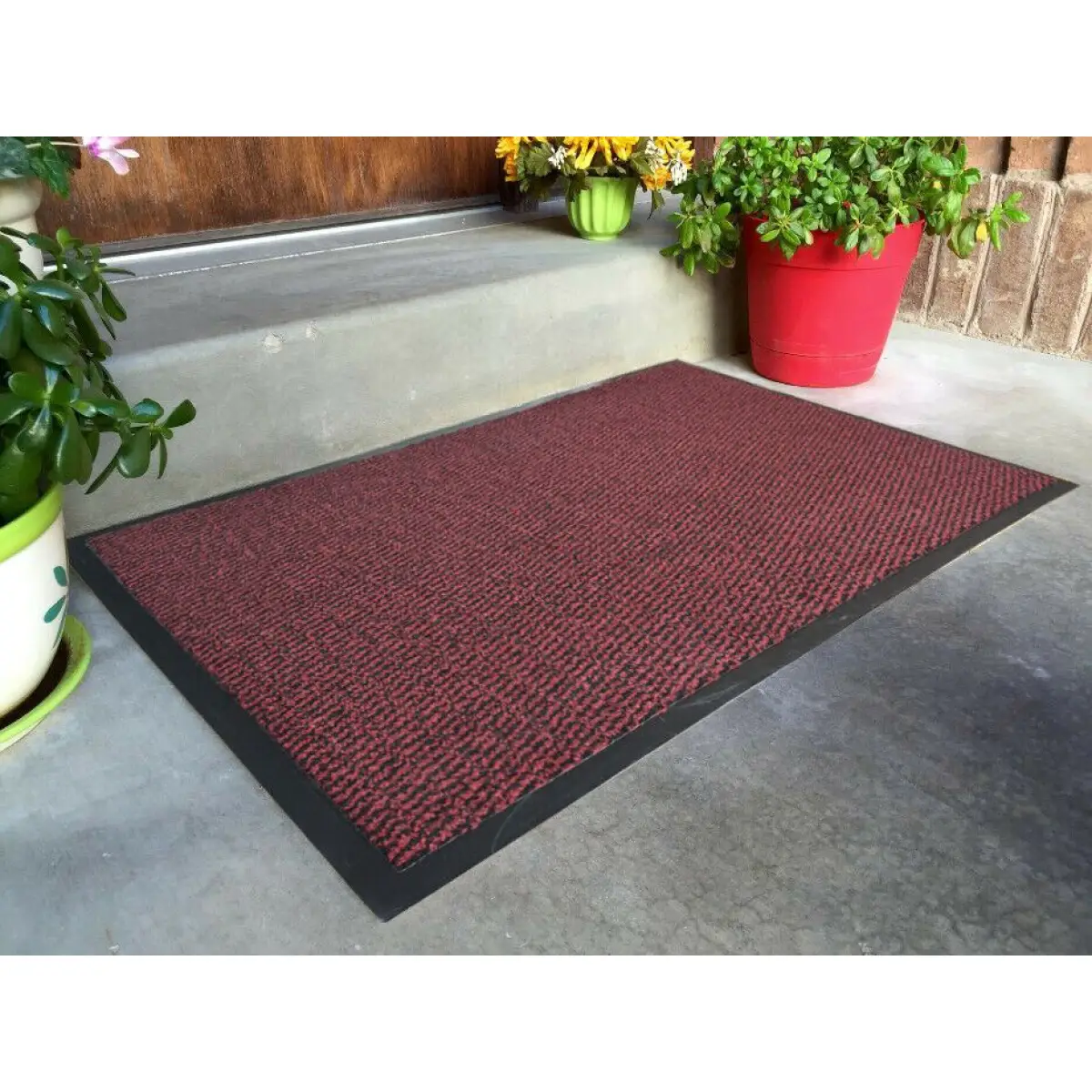
Buying a mat that looks nice rather than one that works. A flat woven decorative rug at the front door will look smart for a fortnight and grim for the two years after that. Barrier mats hold dirt down in the pile, which is why anthracite and grey remain the most popular choices in our range. Brown and rust hide mud particularly well. Red and blue read as a deliberate choice rather than a functional one, which suits an entrance you can see from the living room.
Leaving the mat down all winter without lifting it. Grit works its way through the pile and sits between the mat backing and the floor. That trapped grit, not the mat itself, is what causes fine scratches on wood and laminate. Lift it every few weeks, sweep underneath, let the floor dry, put it back.
Vacuum the mat twice a week through the wet months. Take it outside and shake it properly once a month. Wash the surface with warm water and mild detergent when it needs it, then dry it flat rather than folded or tumble dried.
Getting the mats
All barrier mats at Bossy Cat come with free delivery to the UK mainland and arrive within 3 to 5 working days. There are no hidden fees added at checkout. If a mat turns out to be the wrong size and you would like to send it back, that is fine, though return postage for a change of mind is down to the customer. Anything faulty or damaged on arrival is handled separately, so get in touch and it will be sorted.
Browse the full range of entrance barrier mats, with sizes from 40 x 60cm to 80 x 300cm in grey, anthracite, brown, rust, red and blue.