Two gates can look nearly identical on a listing page and behave completely differently once they're up. The difference is usually how they hold on.
How a pressure fit gate works
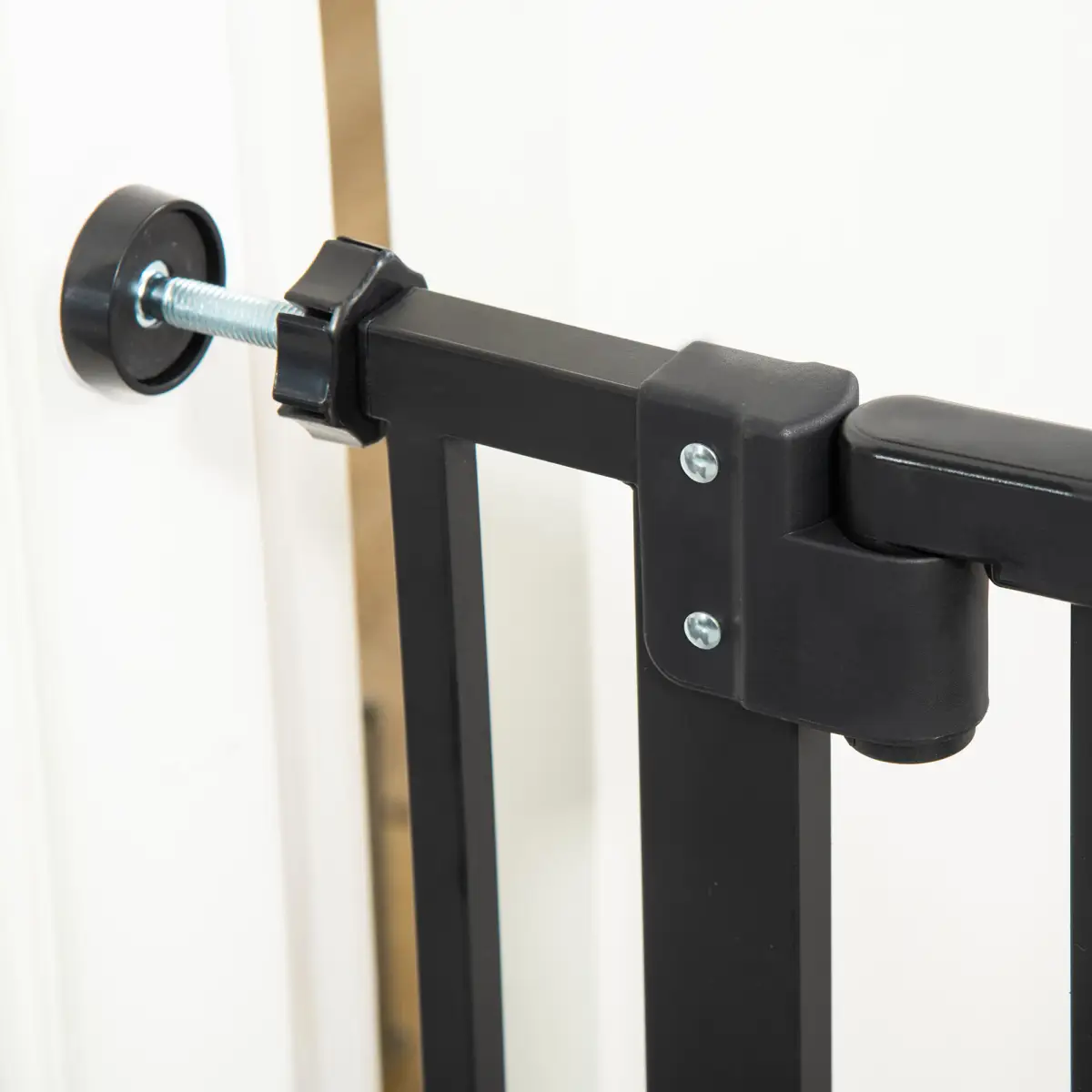
A pressure fit gate holds itself in place by pushing outwards. Four adjustable bolts with rubber pads press against the frame or wall on either side, and friction does the rest. Nothing is drilled, nothing is screwed, and when you take it down there are no holes and usually no marks beyond a bit of dust.
They go up in a few minutes. Adjust the bolts until the gate is snug, tighten the lock nuts, give it a good shove to check it doesn't shift, and you're done.
The catch is that friction has limits. A pressure fit gate will hold against a dog leaning on it, scratching at it, or nosing it. It is less reliable against a fifty kilo dog hitting it at a run. It also relies on both surfaces being reasonably solid and reasonably flat.
How a screw fit gate works
A screw fit gate is bolted to the wall. Small wall cups or mounting plates are fixed with screws and plugs, and the gate hangs off those. It cannot be pushed out of position because it isn't relying on friction at all.
It takes longer to fit. You need a drill, the right plugs for your wall type, and a bit of patience getting everything level. You'll also have four small holes to fill if you ever move it.
In return you get a gate that stays exactly where you put it, indefinitely, no matter what leans on it.
Where each one belongs
The honest answer is that most homes want both, in different places.
Pressure fit suits doorways, room dividers, kitchen thresholds, the bottom of a staircase, and anywhere you might want to move the gate around. It's the obvious choice in rented accommodation where drilling isn't allowed, and it's the one to take with you if you're staying somewhere with the dog.
Screw fit suits the top of a staircase, any spot where a fall would be serious, and any household with a large or powerful dog. It's also the better pick if your walls are uneven enough that a pressure fit gate won't sit square.
The trip hazard nobody mentions
Almost every pressure fit gate has a bar running along the floor between the two uprights. That's the bottom of the frame, and it's structural. Without it the gate would splay.
That bar sits maybe two or three centimetres proud of the floor. In a doorway you step over daily it becomes invisible after a week, but it's a genuine hazard in the dark, at the top of stairs, or for anyone unsteady on their feet. It's another reason a screw fit gate, which has no floor bar, is the sensible choice on a landing.
Auto-close and double locking
These features turn up on both types and they're worth understanding.
An auto-close door swings shut behind you under its own weight. That sounds like a small convenience until you've carried a laundry basket through a doorway forty times a week. It also removes the most common failure point with any gate, which is a human forgetting to shut it.
Double locking means the door needs two separate actions to open, usually a lift and a press, or a slide and a push. It stops a clever dog working the latch with its nose. Some dogs genuinely do learn to do this, and terriers seem to enjoy it most.
Plenty of the gates in the Bossy Cat range combine both, in widths from around 74cm upwards, in black and white finishes.
Extensions and adjustable screws
Wider openings are usually handled one of two ways. Some gates ship with extension panels that clip onto the main frame, adding a fixed amount to the span. Others use long adjustable screws that let you dial in the fit across a bigger range.
Extensions are the tidier solution for a big jump in width. Adjustable screws are better for fine tuning when you're a few centimetres out. Several models in the range include three extensions plus four adjustable screws, which covers most eventualities.
One thing to watch: every extension you add puts more leverage on the fixing points. A heavily extended pressure fit gate is noticeably less rigid than a narrow one. At a certain width, switching to screw fit stops being optional.
If you can't drill
Renting doesn't have to mean compromising. If a pressure fit gate isn't strong enough for the spot you had in mind, the usual answer is to change the spot rather than the gate.
Block the bottom of the stairs instead of the top. Gate the doorway to the landing rather than the stairwell itself. Or move away from wall-mounted gates altogether and use a freestanding folding barrier, which stands on its own support feet and doesn't touch the walls at all.
So which one?
If it's a doorway and you might want to move it, pressure fit. If it's the top of the stairs, or you've got a big dog, screw fit. If you can't drill, rethink where the gate goes.
That top of the stairs question deserves a proper answer of its own, because there's more to it than the fixing method.
Have a look at the pet gates range for pressure fit, screw fit and freestanding options. Free UK mainland delivery, dispatch in 3 to 5 working days.