There is a moment every dog owner knows. The lead comes off, the door opens, and before anyone has reached for a towel the dog is already halfway down the hall leaving a trail across the flooring. The walk was lovely. The next twenty minutes are not.
Most advice about muddy dogs focuses on the towel, the drying coat or the paw washer. All of those help. But the thing that decides how much mess ends up on your floors is much duller than any of them, and it sits on the ground just inside the door.
Dogs and shoes make mess in completely different ways, and a mat chosen for shoes tends to fail badly when a spaniel comes through it.
Why a normal doormat gives up
A shoe has tread. Grit and mud lodge in it, and a coarse mat surface scrapes it out over a few steps. The person wiping their feet is also doing it on purpose.
A paw has none of that. Mud sits flat across the pad and between the toes, water clings to the fur on the legs and belly, and the dog is not going to wipe anything deliberately. It walks straight over the mat at speed, usually in a hurry to get to the kitchen.
That means two things. The mat has to soak up water rather than just scrape, because most of what a dog brings in is wet rather than dry. And it has to be long enough that the dog cannot clear it in a single bound, which a 40 x 60cm doormat absolutely cannot manage for anything bigger than a terrier.
There is a third problem too. A dog usually shakes within a couple of seconds of coming indoors. Whatever is under it at that moment takes the spray. It is worth deciding where you want that to happen.
Getting the length right
For dog owners the useful measurement is length in the direction of travel, not width. The mat needs to cover the distance from the threshold to wherever the dog naturally stops, which is usually where you stand to take the lead off.
Looking at what we stock, this is roughly how it maps out.
90 x 150cm at £18.99 suits a smaller dog and a standard front door. A cocker or a cavalier will cross this in three or four paces, which is enough to pull a decent amount of water out of the pads.
90 x 200cm at £23.99 is the sensible choice for a medium to large dog, or for a back door that opens onto a garden. Labradors, collies and anything with feathering on the legs need the extra run.
80 x 300cm at £29.99 is the runner size. This is the one to look at if you come in through a utility room or a narrow rear hallway, because it covers the whole approach rather than just the threshold.
120 x 180cm at £26.99 works differently. It is wide rather than long, which suits the spot where you actually towel the dog off. If your routine is to block the hall and dry the dog on the spot, the width matters more than the run.
The smaller sizes still earn their place. 60 x 90cm at £11.99 and 40 x 60cm at £8.99 are useful as a second mat further into the house, or beside the crate, or under a water bowl. They are not the mat to put at a back door in February.
Colour, and being honest about it
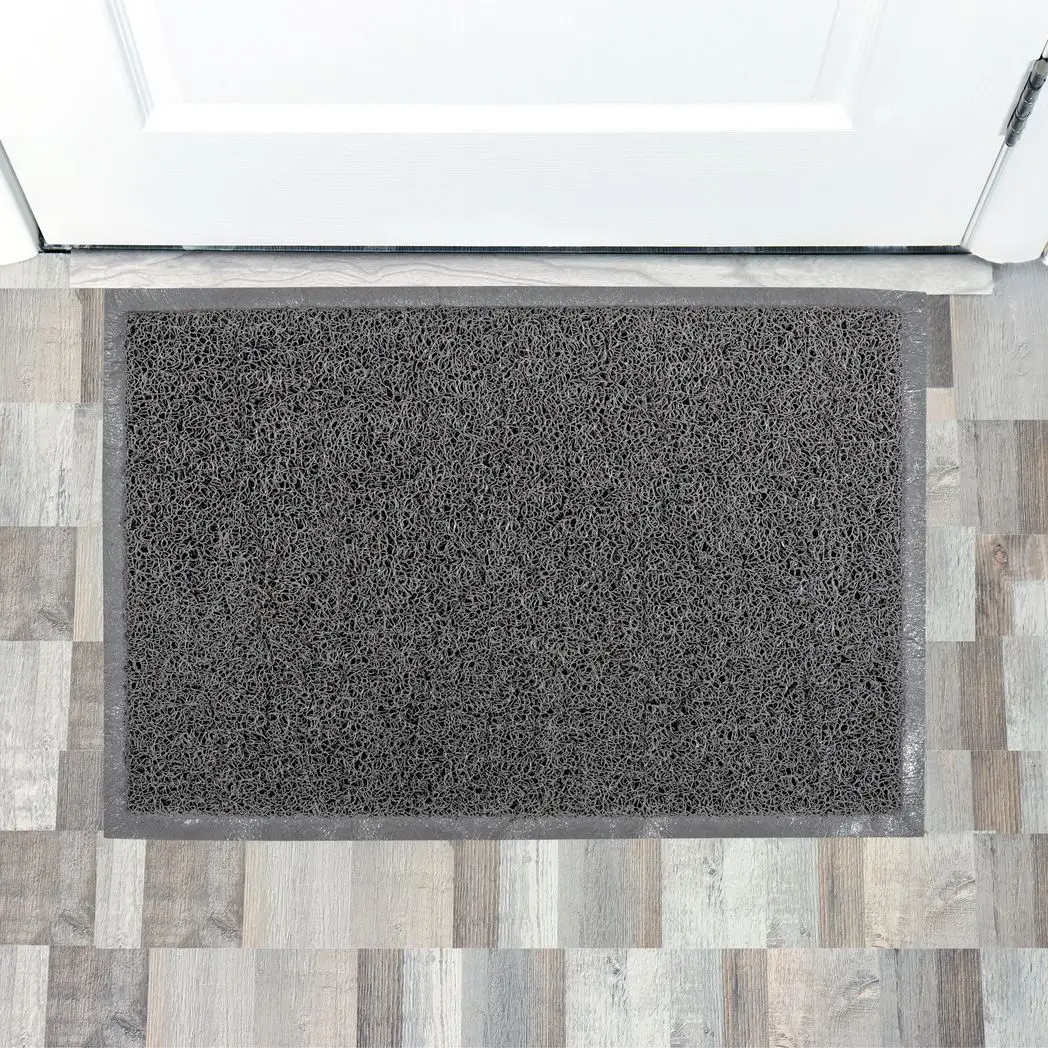
Grey and anthracite hide dirt best, which is why they turn up in every commercial entrance in the country. For dog owners, brown and rust are worth a serious look, because they cope with mud specifically rather than general grime and stay looking presentable for longer between washes.
Red and blue are the choice if the mat sits somewhere you can see from the living room and you would rather it looked deliberate. Just accept that a pale floor with a dark mat will always look tidier than the reverse.
Where the second mat goes
One mat at the door handles the arrival. Dogs then carry damp around the house for another half hour, and the places that suffer are predictable.
The bottom of the stairs is one. The spot beside the crate or bed is another, particularly if the dog goes straight there to settle after a walk. A small mat under the water bowl catches the drips and splashes that otherwise sit on wood flooring and mark it.
None of this needs to be expensive. Two of the smaller mats cost less than one of the runners, and spreading them out does more good than doubling up at the door.
Keeping them usable
Barrier mats hold a lot of water, which is the point, but it does mean they need drying properly rather than being left flat and forgotten.
Vacuum regularly, and more often through autumn and winter. Take the mat outside every few weeks and shake or beat it to release the grit that has worked down into the pile. For a proper clean, wash the surface with warm water and a mild detergent, rinse it, and dry it flat. Do not put it in a tumble dryer and do not leave it folded, because the backing creases and stops sitting flat.
Lift it off the floor every few weeks too. Grit that gets underneath the mat is the usual cause of fine scratches on wood and laminate, not the mat itself.
Ordering
Every barrier mat comes with free delivery to UK mainland addresses and arrives within 3 to 5 working days. No hidden fees at checkout. If the size turns out to be wrong and you would like to send it back, that is fine, though return postage on a change of mind sits with the customer. Anything that arrives faulty or damaged is dealt with separately, so just get in touch.
Have a look at the full range of barrier mats, in sizes from 40 x 60cm up to 80 x 300cm across grey, anthracite, brown, rust, red and blue.