There's a persistent idea that a stair gate is a stair gate and any of them will do anywhere. It isn't true, and the top of a staircase is the one place where getting it wrong has real consequences.
Why the top of the stairs is different
Everywhere else in the house, a gate failing means an inconvenience. The dog gets into the kitchen. Someone finds a chewed slipper. Annoying, not dangerous.
At the top of a flight of stairs, a gate failing means a fall. For an older dog, a puppy with soft joints, or a small breed, that fall can do serious damage. It's also a hazard for anyone coming up the stairs when a dog comes through unexpectedly.
That changes the calculation. It's the one spot where you should be deliberately overcautious.
Screw mounted, every time
The consensus across safety guidance is consistent on this point. A gate at the top of a staircase should be fixed to the wall with screws.
The reasoning is straightforward. A pressure fit gate is held by friction, and friction can be overcome. A dog running at a gate, a person stumbling into it, or simply months of small knocks loosening the bolts can all cause it to shift. It might shift by a centimetre and still look fine. Then one day it doesn't hold.
A screw mounted gate cannot move unless the screws pull out of the wall, and if they're in properly, they won't.
The floor bar problem
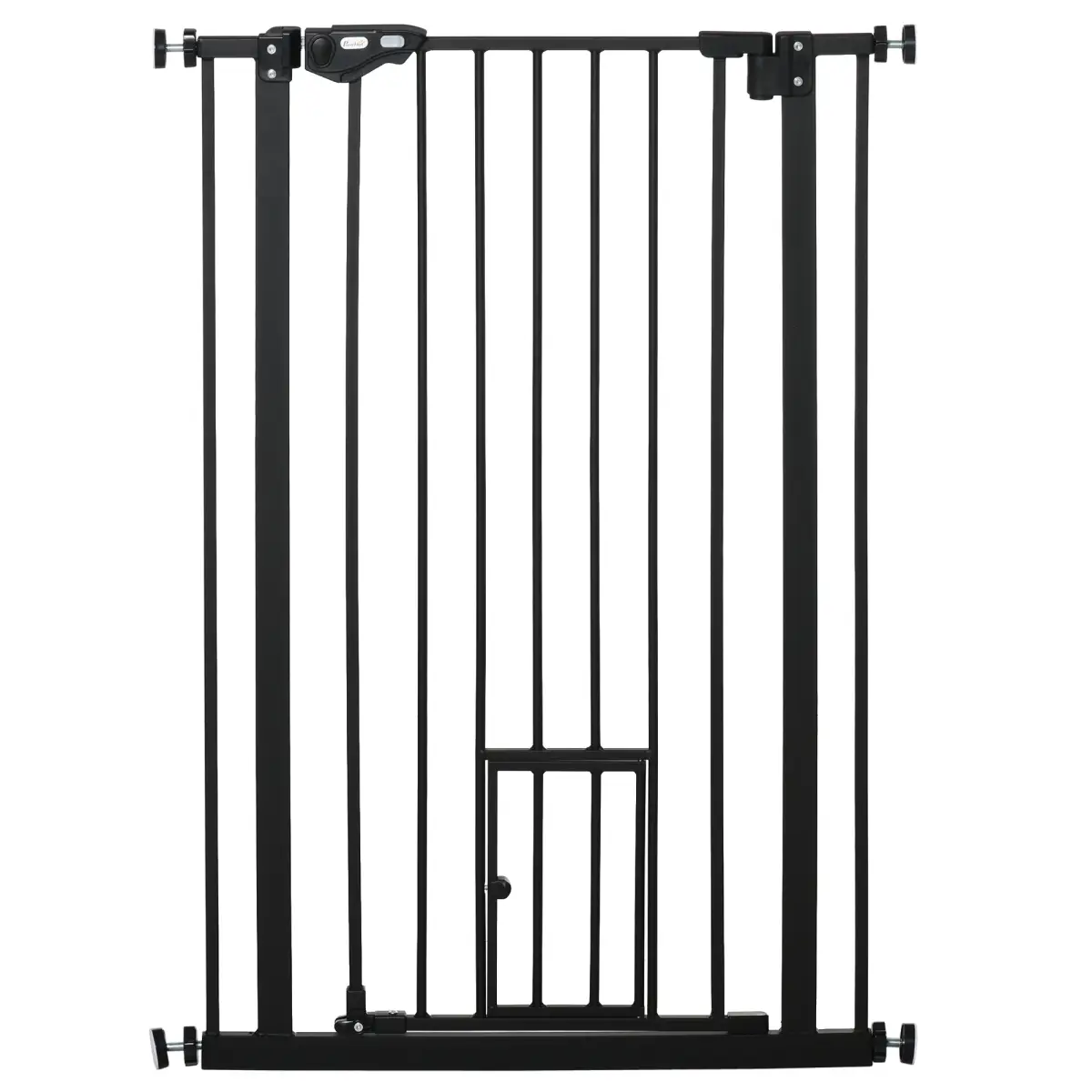
Pressure fit gates have a bar across the bottom of the opening. At the top of a staircase, that bar sits exactly where your foot lands as you arrive on the landing.
Anyone who has caught a toe on one in the dark will tell you it's a genuine risk. If someone trips on the bar at the top of a flight of stairs, the outcome is obvious. Screw mounted gates have no floor bar, which is a second good reason to use one there.
Which way it swings
A gate at the top of the stairs should open away from the stairs, onto the landing. Never over the drop.
If it opens over the stairs, you're standing on the top step, pulling the gate towards you, with nowhere to step back to. Some gates open both ways by design, which is convenient in a doorway and a bad idea on a landing. Check whether the model you're looking at can be set to one-way opening, and set it.
Height and the dogs that jump
A gate that a dog can clear isn't a gate, it's a hurdle. Worse, a dog that half clears a gate at the top of the stairs lands badly.
Measure your dog's shoulder height and be honest about their athleticism. Extra tall models around 106cm exist precisely for this. If your dog has ever got over a gate, even once, even slowly, size up.
Some dogs also climb rather than jump, using horizontal bars as a ladder. Vertical bar spacing and a smooth frame make this much harder.
Check it every month
This is the bit that gets forgotten. A gate is not a fit and forget item.
Once a month, give the gate a firm push at the top and at the middle. Check the screws haven't worked loose and the wall cups still sit flush. On a pressure fit gate, check the lock nuts are still tight and the rubber pads haven't perished or slipped. Check the latch still engages fully rather than catching on the edge.
Two minutes. Set a reminder if you need to.
If you can't fit a screw mounted gate
Plenty of people can't drill, either because they rent or because the walls won't take it. That doesn't leave you stuck, but it does mean changing the approach.
The most reliable option is to gate the bottom of the stairs instead. A pressure fit gate at the foot of a staircase is a sensible use of that design, because a failure means the dog gets upstairs rather than falls down them. It solves most of the same problems.
Alternatively, gate the doorway into the landing area, or the doorway of the room you're trying to protect, rather than the stairwell itself. A pressure fit gate in a normal door frame is a much easier job than one spanning a stairwell opening.
Freestanding folding barriers are worth considering as a room divider, but they're not a stair solution. They stand on support feet and a determined dog can push one over, so keep them well away from any drop.
What good looks like
A gate at the top of your stairs should be screwed to the wall, taller than your dog can jump, opening away from the stairs only, with no bar across the floor and a latch you can work one handed while carrying something.
If your setup doesn't tick all five, either change the gate or change where it goes.
Multi-pet households have an extra wrinkle here, because a gate that stops the dog often stops the cat too, and cats have opinions about that.
Browse pet gates and safety barriers, including extra tall and screw mounted options. Free delivery to UK mainland addresses, dispatched within 3 to 5 working days.