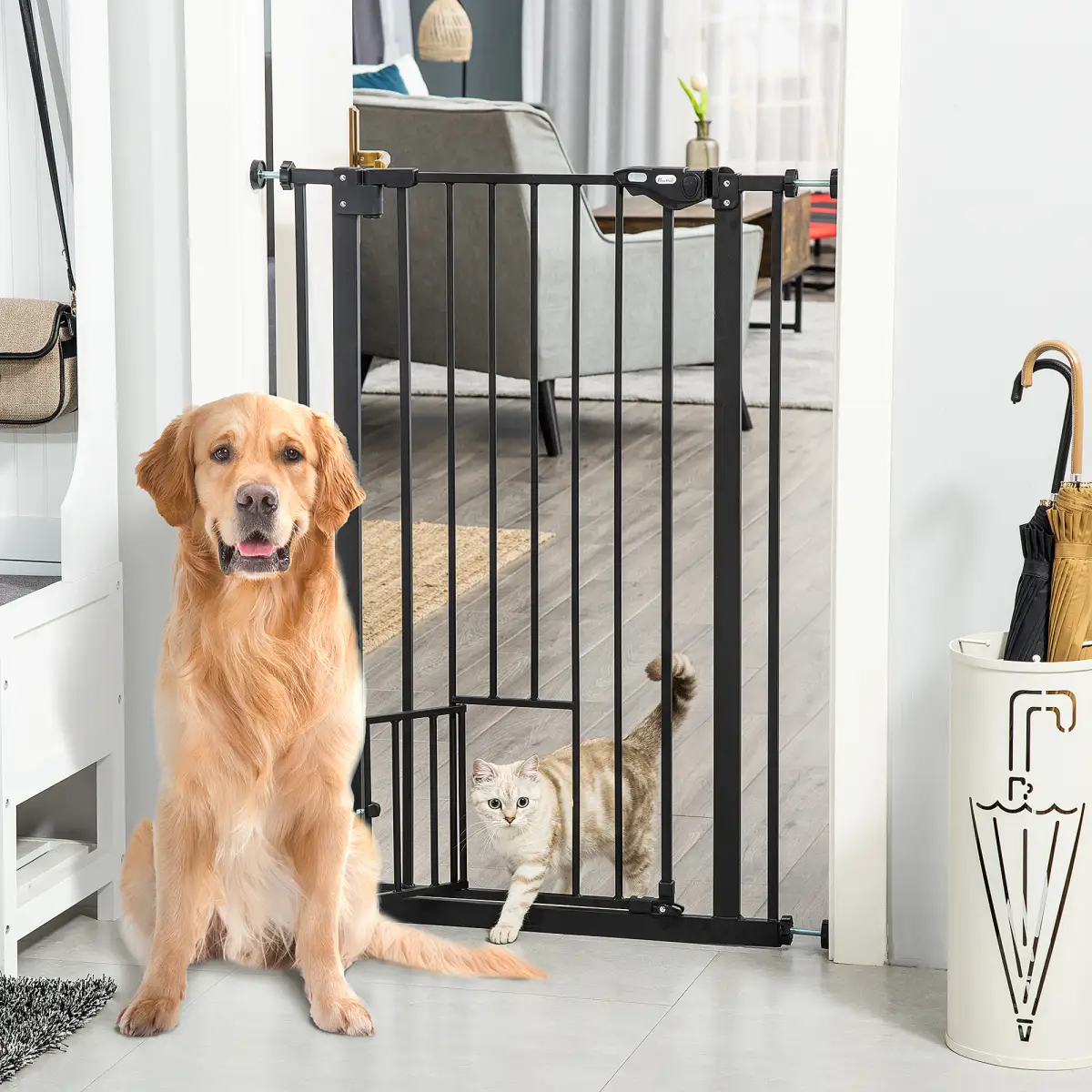
Bring a dog into a house that already has a cat and the first thing you notice is that the cat needs somewhere to go. Not permanently. Just somewhere the dog can't follow.
A standard stair gate solves half the problem and creates the other half. The dog stays downstairs. So does the cat, whether it wanted to or not.
What a cat door gate actually is
It's a normal pet gate with a small opening built into one of the lower panels, usually around 15 to 18cm square. The cat walks through. The dog can't, because the hole is too small and sits too low.
Some have a flap. Some are just an opening. Some have a sliding cover so you can close it off when you want the cat contained too, which is handy at vet appointment time.
Several gates in the Bossy Cat range work this way, in adjustable widths from around 74cm up to 104cm, including extra tall models at 106cm for households with a dog that likes to jump.
Why cats need an escape route
This isn't about spoiling the cat. It's practical.
Cats manage stress by controlling their own space. A cat that can leave a situation is far less likely to escalate it. Take that option away and you get hissing, swiping, hiding under beds, and in some cases toileting outside the tray. Behaviour problems in multi-pet homes very often trace back to a cat that has nowhere to retreat to.
A cat door in the gate means the cat always has an exit. Knowing the exit exists is often enough on its own, even if the cat rarely uses it.
Protecting food and litter
Two flashpoints in any cat and dog household.
Dogs will eat cat food given the chance, and cat food is far too rich for them as a regular thing. Dogs will also, unfortunately, take an interest in the litter tray. It's normal dog behaviour and it's unpleasant for everyone including the cat, who then decides the tray isn't safe and goes elsewhere.
Putting both behind a gate with a cat door solves it neatly. The cat gets to its food and its tray whenever it likes. The dog doesn't get near either.
Put the litter tray somewhere with clear sightlines and more than one route out. Cats don't like being cornered while they're using it.
Will the cat actually use the door?
Usually, yes, but not immediately. Cats are suspicious of new architecture.
Prop the door open or remove the flap for the first week so it's just a hole. Most cats will investigate a hole. Put something interesting on the other side, though not their main food bowl, because you don't want the cat feeling forced through before it's comfortable.
Once they're using the opening confidently, reintroduce the flap if there is one. Some cats never accept a flap and will only use an open hole, which is worth knowing before you buy a model where the flap can't be removed.
Don't push a cat through. One bad experience with a flap catching their tail and they'll refuse it for months.
When the cat just goes over the top
Some cats will look at a 75cm gate, look at you, and clear it without breaking stride. If your cat can jump, a cat door is a courtesy rather than a necessity, and the gate is really only working on the dog.
That's fine, and it's often the ideal outcome. The cat has full run of the house, the dog has a boundary, and everyone's happy. It does mean you should choose the gate for the dog's height rather than worrying about containing the cat.
Where it becomes a problem is if you specifically need the cat contained, for instance while a new cat settles in or during recovery from surgery. In that case a gate isn't the right tool. A closed door is.
Setting up the vertical space
Gates work horizontally. Cats also think vertically, and that's worth using.
A cat that can get above dog height feels safe without needing to leave the room at all. Wall shelves, a tall cat tree, or a cat house on a raised surface all give the cat an option that doesn't involve going through a gate at all. Combining a cat door gate downstairs with high perches in the shared rooms tends to work better than either on its own.
Have a look at the cat trees and cat houses ranges if you're putting that side of things together.
Introducing the two of them
The gate does most of the work in the early weeks, and not in the way people expect. It isn't there to keep them apart forever. It's there so they can see and smell each other without either being able to make a bad decision.
Feed them on opposite sides of the gate, far enough back that neither is tense. Move the bowls slightly closer over successive days. Keep every session short and end it while both animals are still relaxed rather than waiting for something to go wrong.
Most cat and dog introductions that go badly went too fast. A gate is what lets you go slowly.
Browse pet gates, including models with built-in cat doors. Free UK mainland delivery, dispatch within 3 to 5 working days, no hidden fees.