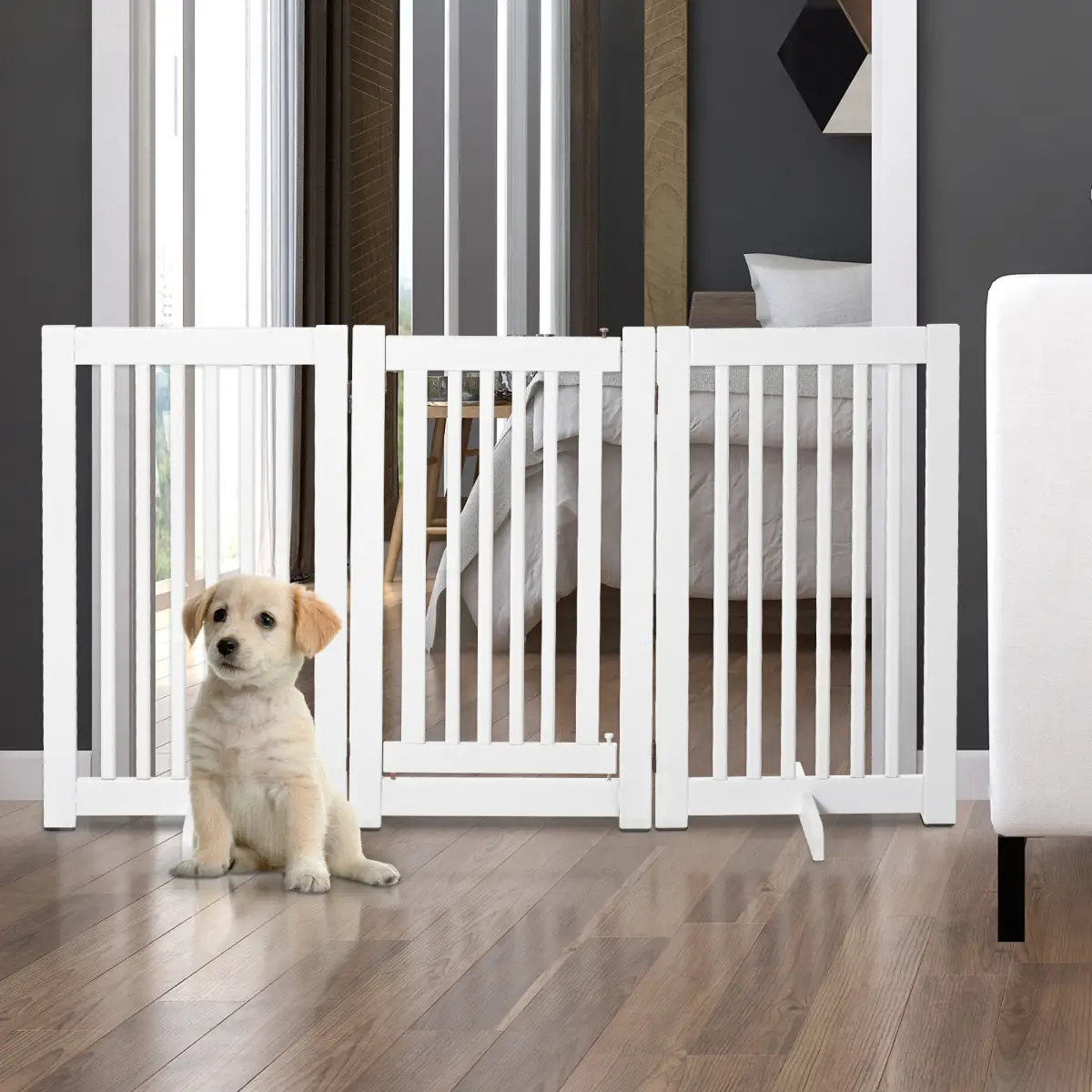
A gate is one of the most useful things you can own when a puppy arrives, and most people underuse it. They put one up to block the stairs and leave it at that. Used properly it does a lot more.
Here's roughly how it plays out.
Before the puppy arrives
Put the gates up first. All of them. A puppy arriving into a house where the boundaries already exist adapts much faster than one that watches you install a barrier on day four in response to something it did.
The usual set is one at the bottom of the stairs, one across the kitchen or wherever the puppy will sleep, and possibly one dividing an open-plan space. Measure your openings before you order, because the ranges are narrower than people expect. There's a full guide to measuring if you want to get it right first time.
Week one: the settling zone
The first job is a small, safe, boring area where the puppy can be left without supervision for short periods.
Gate off a kitchen or utility room. Everything chewable goes above puppy height. Bed at one end, water down, a couple of things it's allowed to destroy. That's it.
Puppies sleep an enormous amount, somewhere in the region of eighteen hours a day at eight weeks, and they need somewhere they can do it undisturbed. A gated room lets you get on with your life while the puppy sleeps, and lets the puppy sleep without being poked by children.
Keep the gate low drama. Don't make a fuss when you go through it. Don't make a fuss when you come back.
Weeks two to four: toilet training
The gated area is what makes house training work. A puppy loose in a five-bedroom house will find somewhere to go and you won't see it happen. A puppy in a gated kitchen is either in your line of sight or on a floor that wipes clean.
Take them out on a schedule. After waking, after eating, after playing, and roughly every hour otherwise. Reward outside, ignore accidents inside, and clean up with an enzymatic cleaner rather than anything with ammonia in it.
As the puppy gets reliable, the gated area gets bigger. One room becomes two. Not all at once.
The stairs, and why the gate stays
Stairs are the thing people relax about too early.
Puppies have soft, developing joints and growth plates that don't fuse until somewhere between nine and eighteen months depending on breed size. Repeated stair climbing during that window puts loading through the hips and elbows that they aren't built for yet, and it's a known risk factor in larger breeds.
Carry them up and down while they're small. Keep the gate on the stairs long after you've stopped needing it for anything else. For a large breed dog you might reasonably keep that gate up for a year and a half.
There's also the simple falling risk. A ten-week-old puppy on a flight of stairs is an accident with a countdown on it.
Visitors, children and the front door
A gate near the front door is worth its weight. Delivery drivers, guests, kids running in from school, all of it becomes manageable when the puppy is behind a barrier rather than shooting past your legs onto the pavement.
Same with children. A gate lets a child and a puppy be in the same house without being in the same space, which is the correct arrangement when either of them is overtired. It also gives the puppy a break from being handled, which puppies need far more than most people realise.
Months two to four: earning the house
Widen the boundaries gradually as the puppy gets more reliable. The order most people find works is kitchen, then hallway, then living room, then the rest.
Go back a step whenever there's a setback. If the puppy has a run of accidents or starts chewing skirting boards, that's information, not disobedience. Shrink the area and rebuild.
For overnight and for longer absences, a crate alongside the gated area gives the puppy a den it actually chooses to use. Worth looking at dog crates if you're going down that route.
If the puppy screams at the gate
Some do. It's usually about being separated from you rather than the gate itself.
Start with the gate open and you on the same side. Then the gate shut with you visible through it, for thirty seconds. Then a minute. Build up slowly and always come back before the puppy gets upset rather than after.
Never let a puppy out while it's screaming, because you've then taught it that screaming opens gates. Wait for two seconds of quiet, then go.
Feeding the puppy near the gate helps. So does giving it something to chew on the moment you leave.
When to take the gates down
Whenever you stop needing them, which for most people is somewhere between six months and never.
Plenty of households keep a gate on the kitchen permanently, because it's genuinely useful to have somewhere the dog isn't when the oven's open or the shopping's coming in. That's not a failure of training. That's a well-run house.
If a standard gate won't fit your openings, that's a solvable problem, and it's the subject of the next post in this series.
See the full range of pet gates and safety barriers. Free delivery to UK mainland addresses, dispatched in 3 to 5 working days.