Everybody measures the width. It's the obvious one, it's printed on the box, and the rule is simple enough that most people already know it. Get a unit a bit wider than the screen and the proportions look right.
Almost nobody measures the height. And height is the one you notice every single evening, because it decides whether you spend two hours looking slightly down at the screen or slightly up at it.
Looking up is the problem. Your neck extends, your shoulders creep forward, and after an hour or so you start shifting about without quite knowing why. It's the same mechanism that makes a badly positioned monitor uncomfortable at a desk, just spread over a whole evening instead of a working day.
The only rule that really matters
Forget the various formulas floating around online. There is one thing to get right.
You should never have to look up at the screen.
Slightly down is fine. Level is fine. Up is the one that causes trouble, and it's the mistake people make most often, usually by mounting a television above a fireplace because that's where the empty wall is.
That's the whole principle. Everything else is working out what it means for your particular sofa.
Working out your number
You do not need a tape measure for the first part. Sit on the sofa where you normally sit, in the position you normally sit in, which for most people is further back and lower than they would admit. Look straight ahead at the wall and note roughly where your gaze lands.
For most adults on a standard sofa, that comes out somewhere around 100 to 110cm from the floor. Sofa seats usually sit between 42 and 45cm, and the rest is torso and neck.
The middle of your screen wants to be at that height or a little below it. So the sum works backwards: take your natural eye height, subtract half the height of your television, and that gives you roughly where the bottom of the screen should sit. Then subtract the height of the TV's own feet or stand, and what's left is the height of the unit you want.
Run that through for a 55 inch television, which is around 68cm tall, and you land at a unit somewhere in the 40 to 55cm range. Which, conveniently, is where most TV units are built. That is not a coincidence. It's why the standard height exists.
Where it goes wrong is when people deviate from it. A tall sideboard pressed into service as a TV stand puts a 55 inch screen well above eye level. So does a wall mount positioned by eye rather than measured.
Floating or freestanding
This is where the decision gets interesting, and it's the bit the "media wall" trend has changed.
A freestanding unit fixes your height for you. Whatever the unit is, that's where the screen goes. Simple, no drilling, and you can move it. Something like the HOMCOM 160cm unit with LED lighting, built for a 65 inch screen at around £86.99, or the oak tone unit with two cupboards and cable management at around £93.99, will put you in the right zone without any thought.
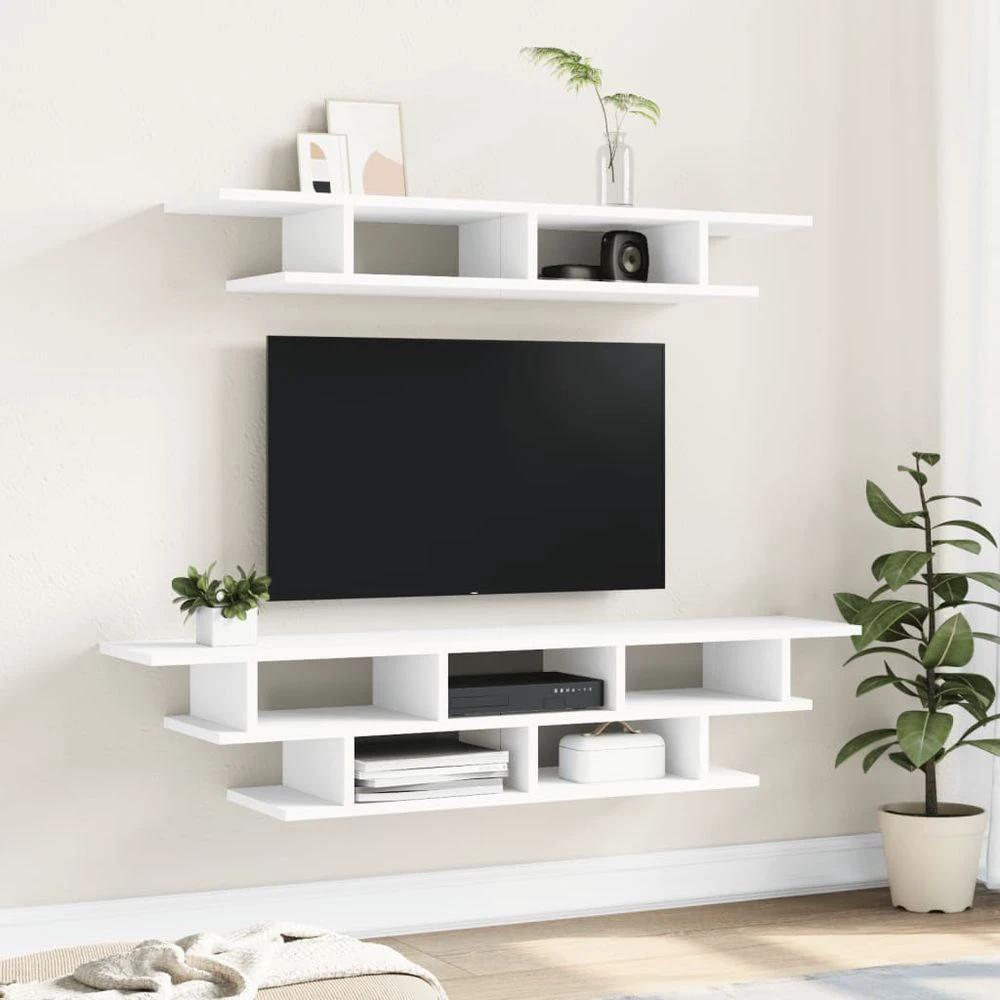
A floating unit lets you choose the height exactly. That's the real advantage, and it's underrated. You fix it to the wall at whatever height suits your sofa rather than accepting a manufacturer's decision. The wall mounted media console in white sits around £40.99, and the larger floating unit built for 60 inch screens with shelves and cabinets is about £79.99.
Floating units also make a small room feel bigger, because you can see the floor underneath and the eye reads the space as continuing. If you have a compact living room, that matters more than the extra hassle of fitting one.
The trade-off is the fitting itself. A floating unit needs proper fixings into something solid. On a masonry wall that's straightforward. On a stud partition or a dot-and-dab plasterboard wall it needs locating into the studs, and if you are not confident with that, a freestanding unit is the sensible answer.
The corner problem
Corner units solve a space problem and create a viewing one. Sitting a television at 45 degrees to the room means anyone on one side of the sofa is looking at the screen at an angle.
That's fine in a room where the seating faces the corner. It's less good in a room where a long sofa runs along one wall. Worth thinking about before buying, because it is the sort of thing that seems obvious in the shop and annoying six months later. If a corner is the only option, the HOMCOM 47 inch corner stand from around £50.99 and the 50 inch rustic brown version at around £85.99 both keep a reasonable footprint.
Materials, honestly
The Bossy Cat range splits into two groups, and it's worth knowing which you are buying.
Most of the range is HOMCOM, built from engineered wood with a finish applied. These are well made, priced from around £39.99 to £100, and perfectly capable of holding a modern television. Engineered wood is stable and does not warp, which is genuinely useful for a long low unit.
The other group is solid timber. Artisan Furniture's compact chestnut mango wood unit sits around £213.99, and the Indian Hub mango and acacia pieces run from roughly £312.99 upwards. These are heavier, they age differently, and they cost more because solid wood costs more.
Neither is the right answer for everyone. Engineered wood makes sense if the unit is essentially a stand. Solid wood makes sense if it's a piece of furniture you want to keep.
Whichever you choose, check the stated weight capacity on the product page against your television's weight. Screens have got bigger and lighter over the years, but a 65 inch set with a wide-footed stand still puts real load on two specific points.
Getting one
Bossy Cat stocks TV units from compact stands up to 160cm wide, in engineered wood and solid timber, including floating and corner designs. Free delivery to UK mainland addresses within 3 to 5 working days, with no hidden fees at checkout. Change of mind returns are accepted, with return postage covered by the customer. Anything faulty or damaged on arrival is handled separately.