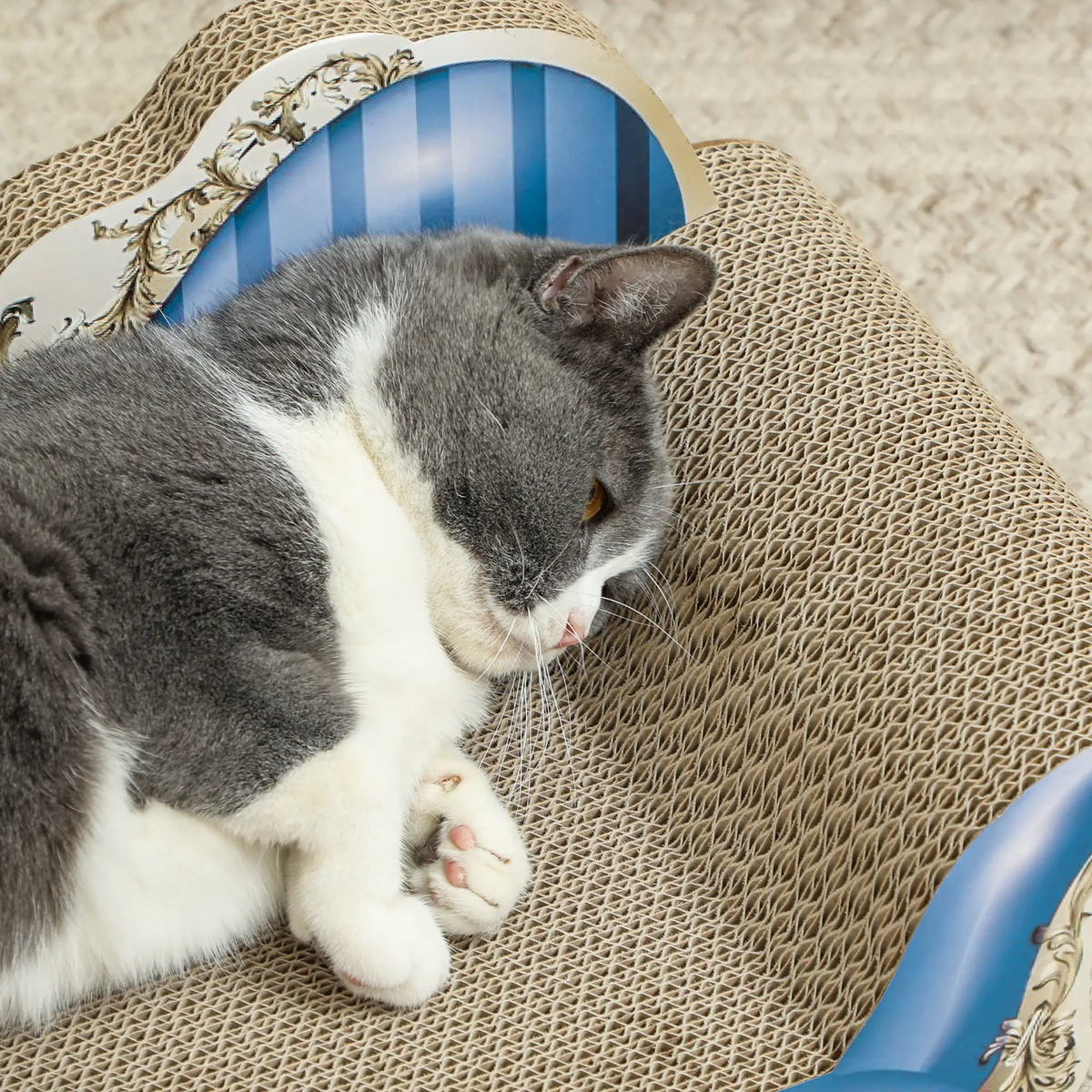
If your cat has picked the arm of the sofa as its favourite scratching spot, you're in good company. It's one of the most common complaints we hear from cat owners, usually followed by a photo of shredded fabric.
The good news is that it's fixable. The less good news is that telling your cat off won't do it. Scratching isn't bad behaviour. It's something every cat needs to do, so the aim is to give them somewhere better to do it.
Why cats scratch at all
It helps to know what your cat is getting out of it.
- Claw care. Scratching pulls off the worn outer layer of the claw and keeps the new one sharp underneath. You'll sometimes find these old claw sheaths on the floor.
- Marking territory. Cats have scent glands in their paws. A good scratch leaves both a visible mark and a smell that says "this is mine".
- A full-body stretch. Watch a cat scratch and you'll see it reach up, dig in and pull back through the shoulders and spine.
- Excitement. Lots of cats scratch when you come home or first thing in the morning. It's a bit like a happy greeting.
Now look at your sofa from your cat's point of view. It's tall, it's heavy so it doesn't wobble, the fabric grips claws nicely and it sits in the middle of the room where everyone hangs out. It ticks every box. To win them over, a scratching post has to tick the same boxes.
Step 1: Work out what your cat likes
Before you buy anything, look at where and how your cat scratches.
Do they stretch up the side of the sofa or the door frame? That's a vertical scratcher. Do they rake the carpet or the doormat? That's a horizontal scratcher. Many cats do both.
Texture matters too. Sisal rope is the most popular choice, but some cats prefer carpet or corrugated cardboard. If yours loves the doormat, a flat cardboard scratcher might be a quick win.
Step 2: Get a post that's tall and steady
This is where most scratching posts fail. A short, light post that tips over the first time a cat leans on it gets abandoned straight away.
Look for a post tall enough for your cat to stretch out fully with front legs extended. For an adult cat that usually means at least 80cm. The base should be heavy or wide enough that it doesn't rock. Give it a firm push in the shop or check the base size in the product details.
For bigger cats or homes with more than one cat, a cat tree with sisal-wrapped posts often works better than a single post, because it's more stable and gives them somewhere to climb and sleep as well.
Step 3: Put it right next to the sofa
It sounds too simple, but placement does most of the work. Put the new post directly in front of, or right beside, the part of the sofa your cat scratches. You're not trying to move them across the room yet. You're giving them a better option in the same spot.
Other good places are near where your cat sleeps, as they often scratch on waking, and near the front door or main entrance to a room. Once the habit has moved, you can shift the post a little at a time to a spot that suits you better. Our guide on where to put a cat tree follows the same thinking.
Step 4: Make the sofa less tempting for now
While your cat is learning, make the sofa a bit less fun to scratch.
- Drape a throw over the arm they target. Loose fabric that moves under their claws isn't satisfying to scratch.
- Stick double-sided tape on the area for a few weeks. Most cats hate the sticky feel.
- Keep the sofa clear of the cushions and blankets they like to knead before a scratch.
Avoid water sprays, shouting or anything that frightens your cat. It tends to make them scratch when you're out instead, and it can make them anxious around you.
Step 5: Reward the right choice
Every time your cat uses the post, make it worth their while. A treat, a stroke or a few words of praise all help. Rubbing a little catnip or silvervine on the post draws a lot of cats over. Dragging a wand toy up and down the post gets them digging their claws in during play.
Step 6: Keep claws in good shape
Regular claw trims mean less damage while you're working on the habit. If you've not done it before, ask your vet or a groomer to show you how much to take off safely.
Declawing is banned in the UK except for genuine veterinary reasons, and it's never the answer to a scratching problem.
Step 7: Give it a few weeks
Most cats switch within two to four weeks if the post is right and in the right place. Older cats with a long-standing habit can take longer. Stick with it, and once the sofa is ignored, you can take the tape off and move the throw.
More than one cat?
In multi-cat homes, cats often like their own scratching spots. A good rule is one scratching post per cat, plus one extra, spread around the house. Tension between cats can also cause more scratching, as they mark their patch more often.
A word on sofa fabrics
If you're replacing a sofa that's already been through the wars, fabric choice helps. Tight, flat weaves are less tempting than loose, loopy fabrics like bouclé. Leather and faux leather don't give the same grip, though they can still mark. Browse our sofas with that in mind.
You'll find sisal posts, flat scratchers and combined units in our scratching posts range, with taller climbing options in cat trees.
Delivery and returns
All orders come with free delivery to UK mainland addresses, usually within 3 to 5 working days, with no hidden fees. If you change your mind, you can send your order back, but return postage is paid by the customer. If something arrives faulty or damaged, contact us and we'll sort it out separately.