A pet gate sounds like one of those simple, one-size purchases. It isn't quite. The gate that's perfect at the top of your stairs is the wrong choice for the kitchen doorway, and the thing you'd use to fence off an open-plan lounge is different again. Buy the wrong type for the spot and you either can't fit it, or worse, you trust it to hold when it shouldn't.
So rather than a list of features, here's a walk around the house. Find the situation that matches yours, and you'll know which kind of gate to reach for.
At the top of the stairs
This is the one to take most seriously, because a fall down the stairs is the injury a gate is really there to prevent, for a wobbly puppy or an older dog alike.
The rule here is simple: at the top of stairs, you want a screw-fit gate, fixed to the wall. A pressure-fit gate holds itself in place with tension against the frame, and while that's fine in plenty of spots, it can in theory be knocked loose by a determined shove, which is exactly the risk you don't want at the top of a staircase. Look for a gate that mounts with screws and, ideally, has a double-locking latch so it can't be nudged open. The adjustable gates in the range that come with fixing screws and extensions are built for this job. Fit it firmly, give it a proper push to check, and you can stop holding your breath every time the dog heads upstairs.
In the kitchen doorway
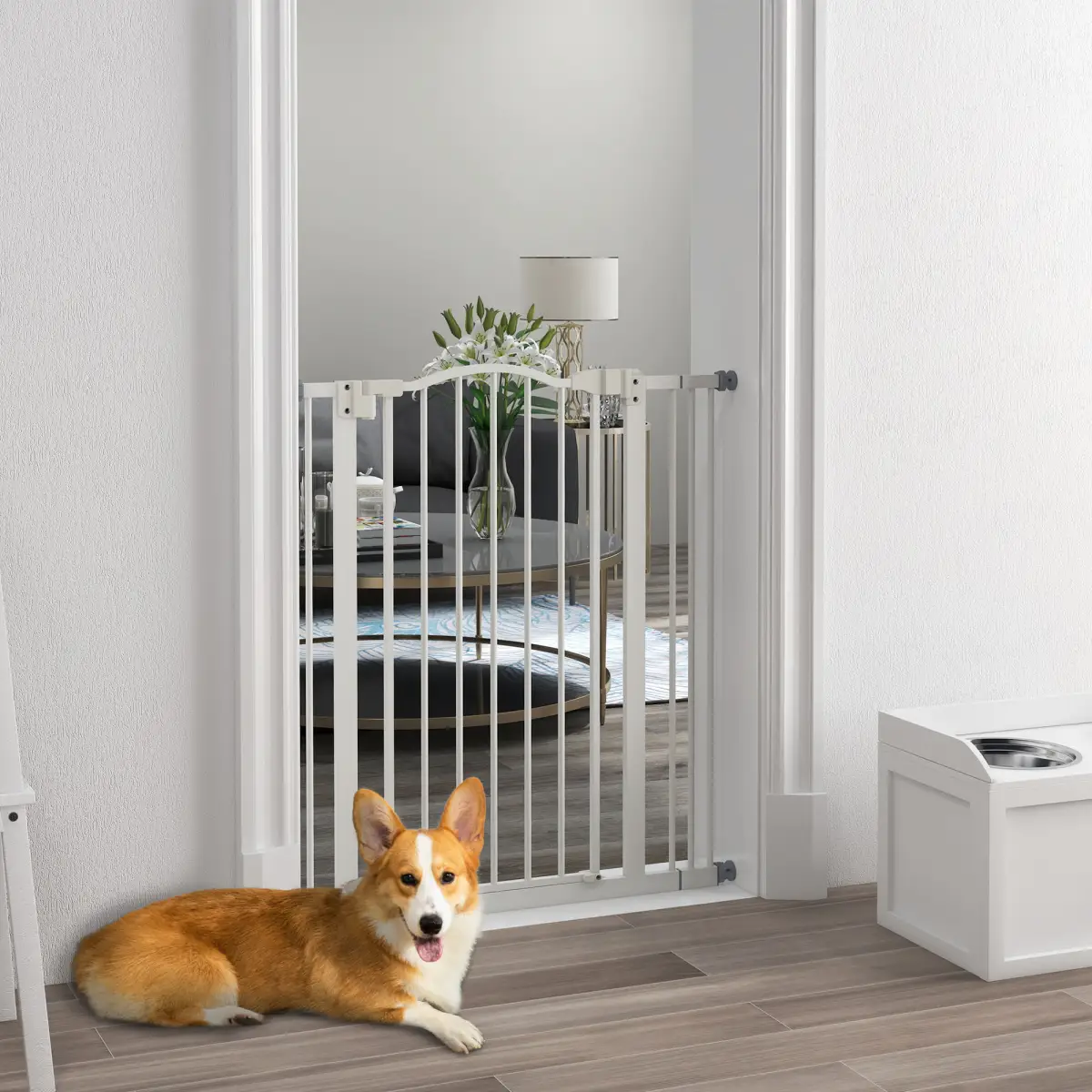
The kitchen is the classic "keep the dog out from under our feet at dinner time" spot, and here you've got more freedom. It's a lower-risk opening than a staircase, so a pressure-fit gate is ideal.
The big advantage of pressure-fit is that it leaves no marks and comes down in seconds, so you're not drilling into the frame of a rented flat or a kitchen you might redecorate. What you really want in a doorway you pass through constantly, though, is a walk-through door with an auto-close mechanism. Being able to push through and have the gate swing shut behind you, rather than bending down or stepping over with a hot pan in your hands, is the difference between a gate you use and one you prop open and defeat the point of. Most of the metal gates here have exactly that, an auto-close door with a lead-free finish, adjustable across roughly 74 to 100cm to fit standard doorways.
Across an open-plan room
Modern open-plan spaces are where fixed gates fall down, because there's often no doorway to fit one in. You're trying to divide a room, not block a gap.
This is the job for a freestanding barrier. The folding wooden gates stand on their own support feet, so they need no wall at all, and they fold away when you don't want them. For a really wide span, the multi-panel playpens stretch a long way, with the six-panel wooden version reaching up to 432cm, enough to cordon off a sofa area or pen a puppy into a safe corner of a big room. Because they're freestanding, you can reshape or move them in seconds, which suits a space that changes use through the day. The trade-off is that a freestanding barrier is a screen rather than a locked gate, so it's for a dog you're managing rather than one you need absolutely contained.
At the bottom of the stairs or a low-risk gap
Not every spot needs the fixed-gate treatment. At the bottom of stairs, or blocking a hallway to keep a dog in one half of the house, a pressure-fit gate is perfectly safe and far more convenient.
Here you can prioritise ease over maximum security. The retractable mesh gates are worth a look for these spots, since they pull across when needed and roll neatly out of the way when they aren't, which keeps a hallway feeling open. It's the kind of gate you barely notice until you need it.
In a multi-pet home
If you've got a cat and a dog, the usual problem is wanting to keep the dog out of a room while letting the cat carry on as normal. A standard gate blocks both, and most cats will simply hop over it anyway.
The neat solution in the range is the pressure-fit gate with a small cat door built into it. The cat slips through its own little opening while the dog stays firmly on the right side, which sorts out feeding stations, litter trays and the cat's bolt-hole in one go. It's a small feature that quietly solves one of the most common headaches in a two-species household.
Whichever spot you're buying for, measure first
One rule cuts across all of these: measure the gap before you order. Every gate fits within a set width range, so measure the opening at the exact height the gate will sit, because skirting boards and uneven walls mean the gap at the bottom often differs from the gap higher up. Check your measurement falls inside the gate's stated range and you'll avoid the most common disappointment, which is a gate that arrives an inch too narrow for the space.
A couple of other quick pointers. Pressure-fit gates take minutes to set up with no tools, screw-fit ones take a little longer but come with the fittings, and the freestanding barriers are the easiest of all, since they just unfold and stand. And with a large or powerful dog, lean towards the sturdier fixed and double-locking options wherever you can.
You can see the whole pet gates range, and if it's a contained safe zone you're really after, the pet playpens are worth a look too, along with the wider dog supplies section.
Every order comes with free delivery to UK mainland addresses, dispatch within 3 to 5 working days, and no hidden fees. If you change your mind, returns are welcome, though the return postage would be down to you in that case, while anything faulty or damaged is handled separately by the team.