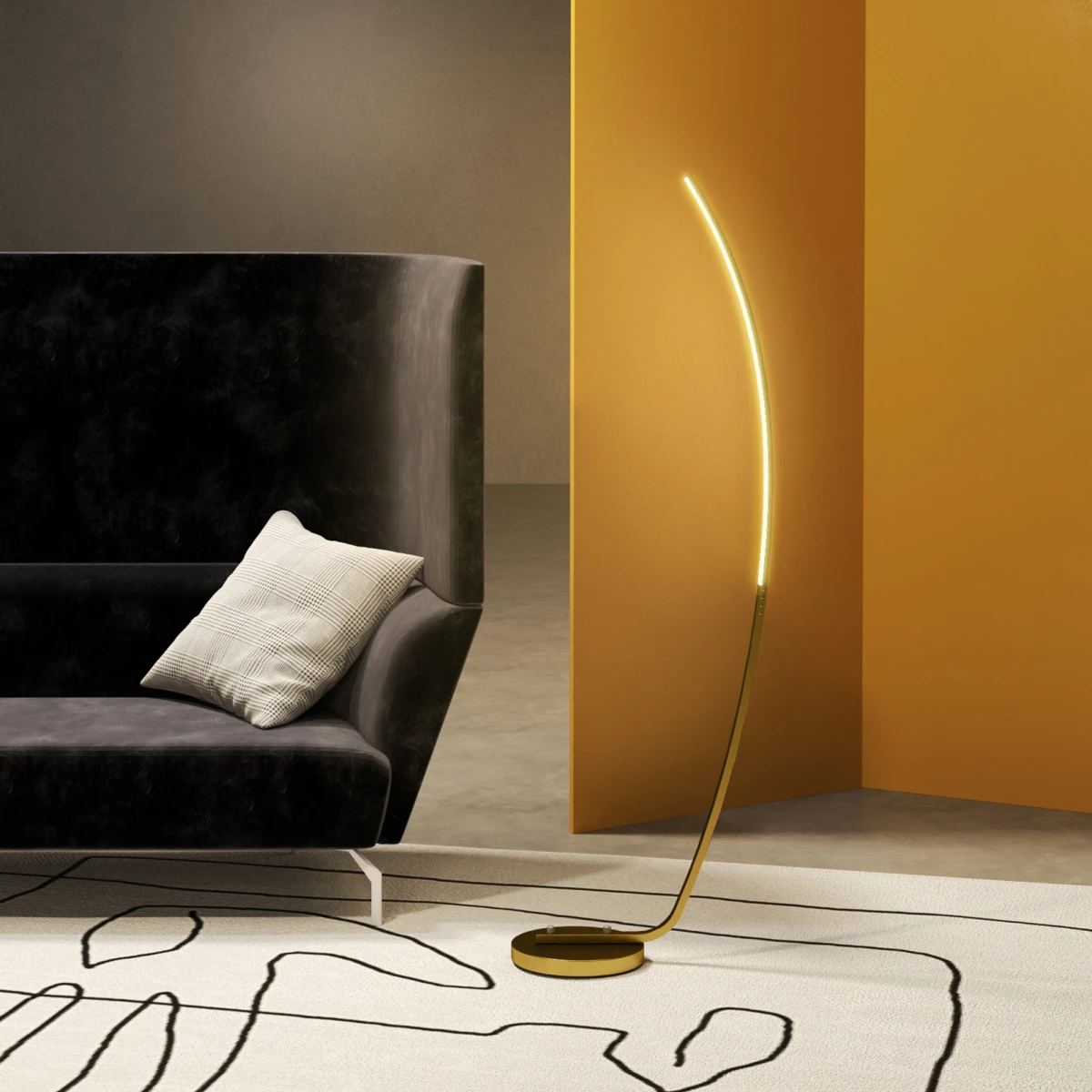
A curved floor lamp is one of the few pieces of lighting that changes a room before it is even switched on. The sweep of the arm draws the eye upward and outward, which makes a low room feel taller and a plain corner feel deliberate. It is also the only floor lamp that puts light where a ceiling pendant would, without anyone touching the wiring.
That combination is why the shape keeps coming back into fashion. Getting the best out of one, though, depends far more on where it goes than on which model gets bought. This guide covers the placement, the proportions and the styling.
Where the base goes, and where the light lands
The single most common mistake is treating a curved lamp like a standard floor lamp and standing it in the corner facing the wall. The arc exists to carry light out over furniture, so the base belongs behind or beside the seating rather than tucked away from it.
The working measurement is head height. When someone is sitting on a sofa, the top of their head sits at roughly 110cm to 120cm from the floor. The shade wants to sit somewhere between 40cm and 50cm above that, which puts it a little over head height and slightly forward of where a person's shoulders are. From there the light falls onto a book or a lap rather than into anyone's eyes.
The base should sit close enough to the sofa that the arc genuinely overhangs it. If the shade is hovering over the floor in front of the sofa rather than over the seat, the lamp has been pushed too far back and the effect is lost.
Height and ceiling proportion
Arc lamps come in two broad heights, and they behave very differently.
Taller models, in the 180cm to 220cm range, produce the dramatic sweeping look most people picture. They need ceiling clearance to work. In a room with ceilings under 2.4 metres, which covers a good many UK new builds, a tall arc can feel like it is pressing down on the space rather than opening it up.
Shorter models around 150cm to 160cm are the safer choice in an average room. The arc is gentler and the shade sits lower, which suits a standard sofa well and leaves a comfortable gap to the ceiling. Both lamps in the Bossy Cat Arched Floor Lamps range fall into this shorter bracket at around 155cm, which makes them straightforward to place in rooms where a taller lamp would overwhelm.
The rule of thumb is simple enough. Measure ceiling height first, then subtract the lamp height. Anything under 40cm of clearance will look cramped.
Single arc or multi-head
The classic arc lamp carries one shade at the end of a long curve. It reads as elegant and quiet, and it does one job well, which is lighting a specific spot.
Tree-style arc lamps carry two, three or more heads on separate arms. These behave differently in a room. Instead of one pool of light they spread several smaller ones, and where the heads rotate independently they can be aimed at a chair, a bookcase and a wall at the same time. The three-head model in the Bossy Cat range does exactly this, with rotating lights on a steel frame.
Neither is better. A single arc suits a room where the lamp is meant to be a quiet, sculptural presence. A multi-head suits a room that needs to do several things at once, such as an open-plan living space or a room used for both reading and working.
Which interiors suit the shape
Curved lamps sit most comfortably in schemes with clean lines. Mid-century, Scandinavian and minimalist rooms all suit them, because the arc supplies a curve in a setting that is otherwise mostly straight edges and rectangles. In a room full of boxy furniture, that single sweeping line does a lot of work.
Industrial schemes take them well too, particularly black steel frames against exposed brick or dark paint.
Where they struggle is in heavily traditional rooms. A curved arc lamp next to a chesterfield, a patterned carpet and a mahogany sideboard tends to look like it wandered in from a different house. Rooms with a lot of existing curves, such as those with round tables, arched alcoves and heavily curved sofas, can also end up looking busy rather than considered.
Finish matters more than shape here. Black frames disappear into a room and read as neutral. Brass and chrome announce themselves and want to be echoed somewhere else, whether in a mirror frame, door handles or the legs of a coffee table.
Layering with the rest of the lighting
An arc lamp works best as one of three light sources in a room, not the only one.
The usual approach is to combine a general source, a task source and an accent. A ceiling light handles general, the arc lamp handles the task of lighting a seating area, and a table lamp or wall light adds an accent at a lower level. Rooms lit from one source overhead always feel flat, which is why so many living rooms look better once a floor lamp arrives.
Where a room is open-plan, an arc lamp also does a job that furniture alone cannot. Positioning one over the seating area draws a line between the living zone and the dining or kitchen zone, without anything being physically moved.
Bulbs and light quality
Most arc lamps take standard E27 bulbs, sold separately.
Colour temperature makes more difference to how a room feels than almost anything else. Warm white at around 2700K produces the soft yellow light that suits living rooms and bedrooms. Cool white above 4000K is closer to daylight, which is useful in a home office and unwelcoming in a lounge.
For brightness, a reading spot wants somewhere in the region of 600 to 800 lumens. Ambient light in the corner of a room can sit lower, around 400 to 600. Dimmable LED bulbs are worth the small extra cost, since the same lamp then serves for reading in the afternoon and atmosphere in the evening.
Mistakes worth avoiding
Placing an arc lamp in a walkway is the most frequent one. The arm extends a long way from the base, and an arc at head height in a route between the door and the sofa will be walked into.
Underestimating the base is another. Arc lamps are cantilevered, so the base needs weight to counter the arm. That weight is what keeps the lamp upright, and it also means these are not lamps to be moved around casually once positioned. In a house with young children or boisterous pets, they belong in a low-traffic corner.
And finally, buying by photograph rather than by measurement. Arc lamps photograph beautifully in large, high-ceilinged rooms. Checking the height and the reach against the actual room prevents an expensive disappointment.