Most British living rooms have one light in the middle of the ceiling, and it's almost never above the place you actually sit. So you end up reading in your own shadow, squinting at a book while a bulb glows uselessly over the coffee table three feet away. Table lamps help a bit, but they light the table, not you.
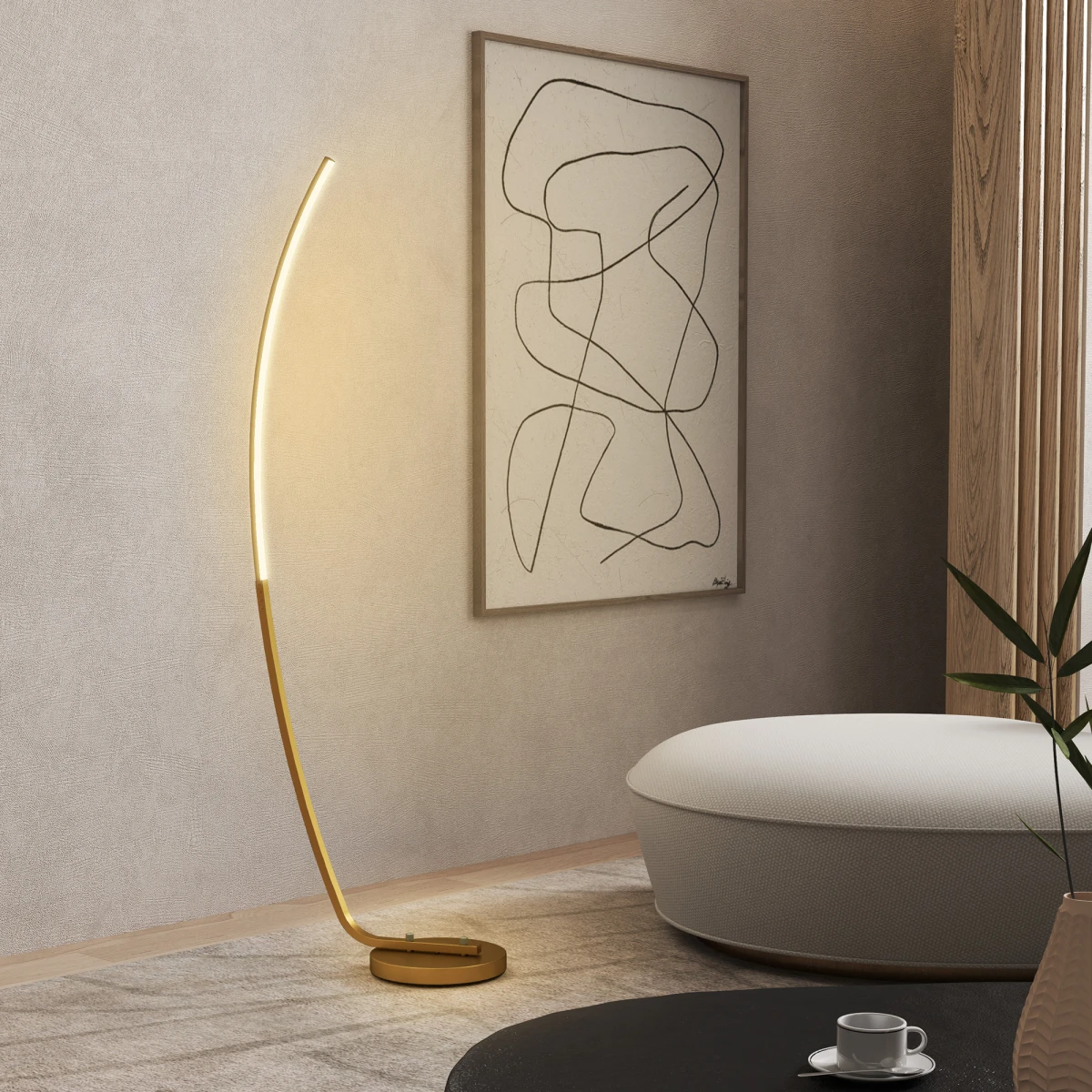
An arched floor lamp fixes this in the simplest way possible. The base stands on the floor beside or behind your sofa, and the arm curves up and out, dropping the shade directly over where you're sitting. You get light coming down from above, exactly like a pendant, without touching the ceiling or calling anyone in to wire it.
Here are the specific problems these lamps are good at solving, and how to pick one that does the job.
Problem one: you rent, and you can't drill
This is the big one. If you're renting, hanging a pendant over the sofa isn't happening. Even if you own the place, running a new ceiling point means an electrician, a bill, and a hole in the plaster you'd rather not make.
An arc lamp gives you the same effect for the price of a lamp and the effort of plugging it in. It goes where you want it, it moves when you rearrange the room, and it comes with you when you leave. If your lighting has always felt a bit stuck because the ceiling rose is where the ceiling rose is, this is the easiest fix there is.
Problem two: your reading corner is too dark
Reading light needs to come from above and slightly behind you. That's why library lamps and hotel reading lights are positioned the way they are. Anything at desk height throws light across the page and creates glare, and anything in front of you casts your own shadow over the book.
An arched lamp naturally lands in that sweet spot. Put the base just behind the arm of your chair and let the shade hover over your shoulder, and suddenly a corner that never quite worked becomes the nicest seat in the house. The HOMCOM arc lamp with its flexible design, at around £65, is built for exactly this, letting you angle the light where you want rather than accepting where it happens to point.
Problem three: an open-plan room with no edges
Open-plan living is lovely until you realise nothing feels like anywhere. The sofa area bleeds into the dining area which bleeds into the kitchen, and the whole thing feels a bit like a waiting room.
Lighting is the cheapest way to draw those lines. A tall arc lamp leaning over the seating creates a pool of light that quietly says "this is the living bit," and the eye reads that boundary even though there's no wall. Because the arc is up in the air, it does this without adding any clutter at floor level, which matters when you're trying to keep an open room feeling open.
Problem four: you want three lights, not one
Not every arched lamp is a single big shade. The tree-style models split the arc into several arms with separate heads, and they're worth knowing about because they solve a different problem.
Take the HOMCOM arc tree lamp at around £37, a 155cm steel frame with three adjustable rotating lights. Each head points where you like, so you can send one down onto your book, one up at the ceiling for a soft wash, and one across at a plant or a picture. It gives you layered light from one plug socket, which is a lot of flexibility for very little money. If your room is short on sockets, or you just want more control than a single fixed shade allows, that's the one to look at.
Getting the position right
Two things stop an arc lamp from working, and both are easy to avoid.
The first is putting it in a walkway. The whole point of the design is that the arm reaches out into the room, so if that arc crosses the route from the door to the sofa, someone's going to walk into it eventually. Tuck the base into a corner or behind the seating and let the arm reach in, rather than sticking it out into open floor.
The second is height. As a rough rule, you want the shade sitting comfortably above head height when you're seated, so the light falls over your shoulder rather than into your eyes. If the shade is too low, you'll spend the evening looking at the bulb. And in a room with a low ceiling, a tall arc can feel a bit much, so check the lamp's height against the space you've got before you commit.
The bulb makes more difference than people expect
You can buy the right lamp and still be disappointed if you put the wrong bulb in it. Most take a standard screw fitting, so this bit is entirely in your control.
For reading, go brighter. For atmosphere, go softer and warmer. Better still, use a dimmable LED, which lets one lamp do both jobs depending on whether you're settling in with a book or watching a film. It's a small thing that transforms how useful the lamp actually is.
Worth knowing before you buy
Arc lamps need a bit of weight in the base to balance that reaching arm, which is what keeps them upright when someone brushes past. That's a good thing, though it does mean they aren't the easiest lamps to shift about on a whim, so pick your spot with a bit of thought. If you've got a busy household with small children or a boisterous dog, keep the lamp out of the main run of traffic.
You can see both arc designs in the arched floor lamps range, and it's worth browsing the wider floor lamps selection too if you'd like to compare them against a tripod or LED style before deciding.
Every order comes with free delivery to UK mainland addresses, dispatch within 3 to 5 working days, and no hidden fees at checkout. If you change your mind, returns are welcome, though the return postage would be down to you in that case, while anything faulty or damaged is handled separately by the team.