The short answer is one tray per cat, plus one spare. Two cats, three trays. Three cats, four trays.
Most people's reaction to that is that it seems excessive, and in a small flat it can feel it. But the rule has been standard advice among cat behaviour specialists for years, and the reasoning holds up once you understand what a litter tray means to a cat.
Why the spare tray matters
A litter tray isn't just a toilet. For a cat it's a resource, in the same category as a food bowl or a favourite windowsill, and cats in the same household quietly compete over resources without ever having an obvious fight about it.
What that looks like in practice is one cat sitting in a doorway while the other waits. Or a cat that stops using a tray after a bad experience there and starts going behind the sofa instead. The spare tray removes the pinch point. If one tray is occupied, dirty or being guarded, there's always another.
It also gives you a buffer. Cats can be particular about how clean a tray is, and with two cats sharing, a tray fills up twice as fast.
Trays in different places, not in a row
This is the bit that gets missed most often. Three trays lined up along the same wall count as one location as far as a cat is concerned. If one cat blocks that corner, all three are unavailable.
Spread them out. Different rooms if you can, and different floors in a house. A hallway, a utility room and a spare bedroom will serve two cats far better than three trays in the same bathroom.
In a one-bedroom flat where there genuinely isn't the space, two trays at opposite ends of the flat is a reasonable compromise, and better than three crammed together.
Size, and why bigger helps more with two cats
The usual guide is that a tray should measure about one and a half times the length of your cat, nose to base of tail. That gives room to turn, dig and cover without stepping in anything.
With two cats sharing, err larger. Cats that feel cramped tend to hang their back end over the edge, which is how litter ends up on the floor, and a small tray fills faster so the second cat arrives to find it already used.
The XXL stainless steel boxes and the extra large high-sided designs in the Bossy Cat range are worth looking at for exactly this reason. Steel has a practical advantage in a multi-cat home too, since it doesn't scratch or absorb odour the way plastic does after a couple of years of heavy use.
Hooded, open, or one of each
There's no single right answer, and in a two-cat home the sensible move is often to provide both.
Open trays suit cats that like to see what's coming. Nothing blocks the view, and nothing traps them if the other cat wanders past. Nervous cats and older cats often prefer them.
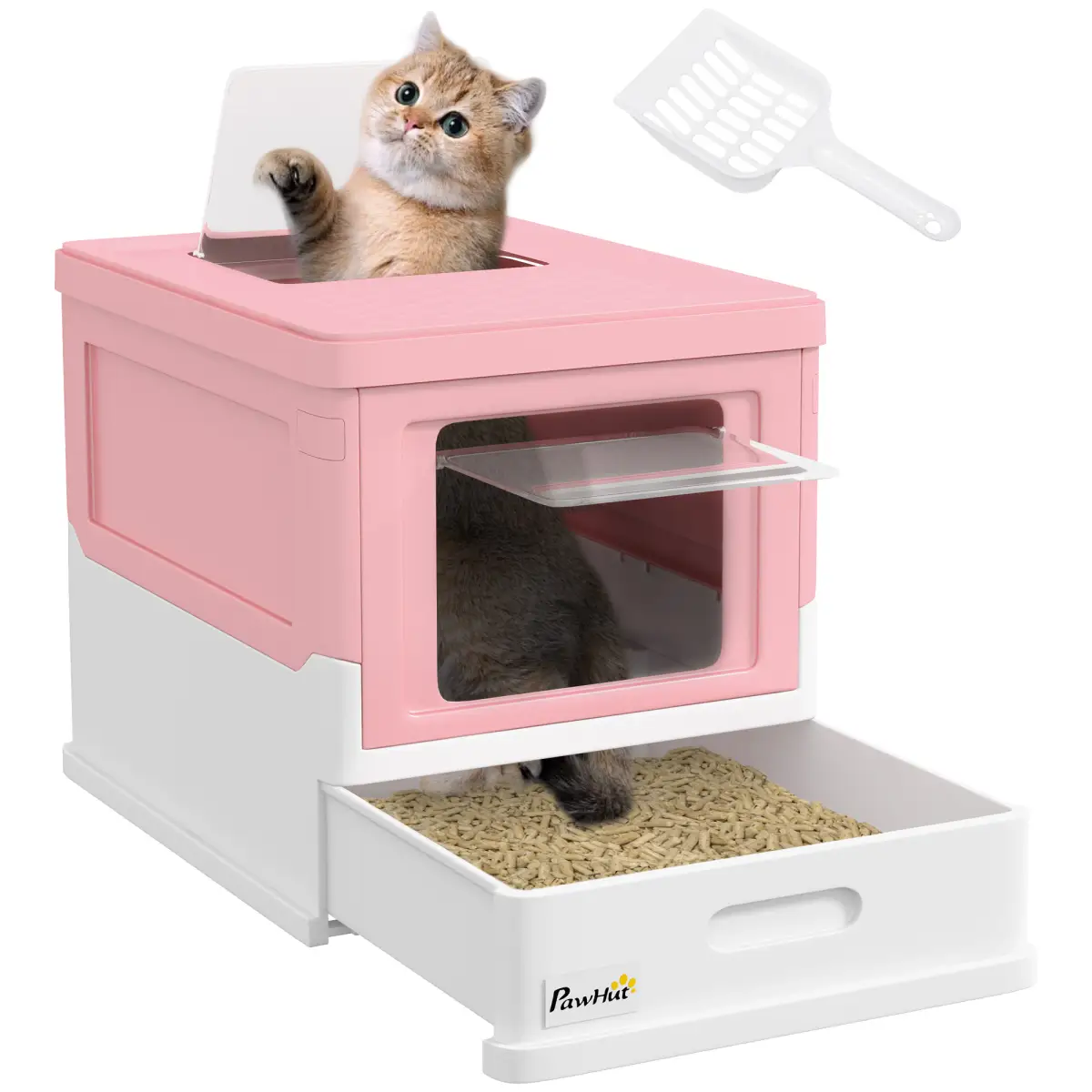
Hooded and fully enclosed trays give privacy and contain odour, which matters if a tray has to live in a kitchen or hallway. Top entry designs cut down on litter being tracked across the floor, since the cat climbs out through the roof and leaves most of it behind.
If your two cats have different temperaments, giving them the choice usually settles the question for you within a week. Watch which tray gets used and buy accordingly.
Cleaning
Scoop daily as a minimum, twice daily with two cats if you can manage it. Full change of litter once or twice a week, with a rinse of the tray at the same time.
Avoid strong-smelling disinfectants. Anything with a heavy citrus or pine scent tends to put cats off, and the residue lingers longer than you'd think. Warm water and a mild unscented detergent is enough.
A litter mat under each tray catches most of what gets carried out on paws, and it costs a lot less than the vacuuming it saves.
When one cat stops using the tray
If a cat that was reliably clean starts going elsewhere, don't assume it's behavioural and don't assume it's spite. Cats are not spiteful, and a change in toilet habits is one of the more common early signs that something physical is wrong.
Speak to your vet first. Once that's ruled out, then look at the setup: whether a tray has been moved, whether a new hood has been fitted, whether the litter type has changed, or whether one cat has started blocking access to a particular room.
Getting the numbers right from the start
If you're bringing a second cat home, add the extra trays before the cat arrives rather than after. Introducing a new cat and reorganising the toilet arrangements in the same week gives the resident cat two things to be unsettled by instead of one.
Three trays is a nuisance to buy and easy to put off. It's still a great deal less trouble than cleaning a carpet.
Delivery and returns
Free delivery on all orders to UK mainland addresses, dispatched within 3 to 5 working days, with no hidden fees at checkout. If you change your mind or order the wrong item, returns are welcome, though the return postage cost is yours to cover in those cases. Anything faulty or damaged is handled by the Bossy Cat team.