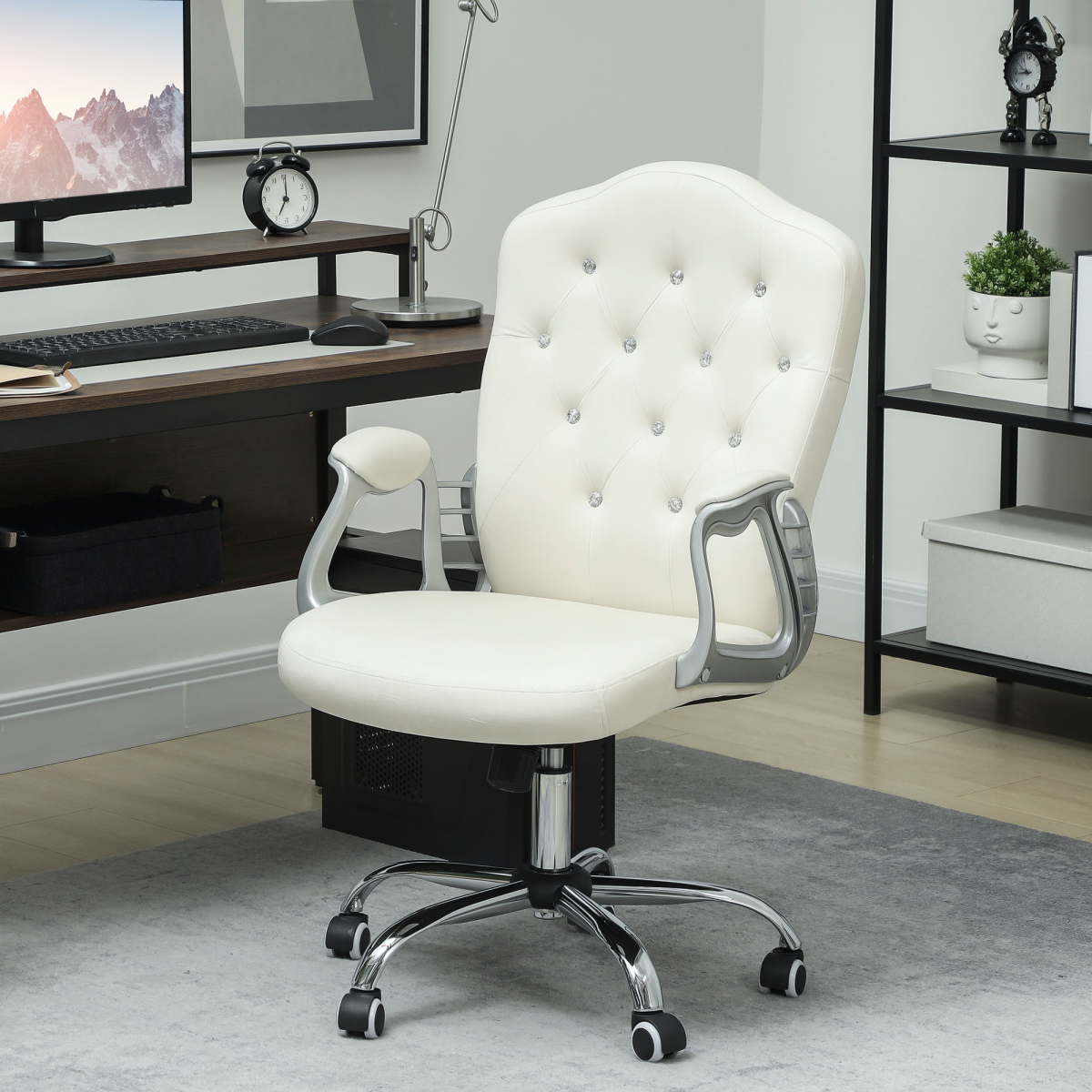
A desk chair puts all your weight onto five small castors, then rolls them over the same patch of floor hundreds of times a day. On carpet, that wears a flattened, grey track. On wood or laminate, it leaves fine scratches that get worse each month.
An office chair mat stops that, but only if you buy the right one. The thing that matters most isn't the size or the price. It's what's underneath: carpet and hard floor mats are built differently, and the wrong one can cause the damage you were trying to avoid.
Here's how to pick one, using real products from our office mats range.
Start with the floor, not the mat
Every chair mat is made for one of two floor types, and the underside tells you which.
Carpet mats have small grippers on the back. They press into the pile and stop the mat creeping across the room every time you push your chair back.
Hard floor mats have a smooth back. That's deliberate. Grippers on wood, laminate or tile can dent or scratch the very surface you're protecting, so never put a carpet mat on a hard floor.
The Floortex Ultimat polycarbonate mat shows this clearly. It comes in three versions: a gripper back for carpets up to 12mm, a gripper back for carpets over 12mm, and a smooth back for hard floors. Same mat, three different undersides.
If you have a rug over a hard floor, treat it as carpet and choose by the rug's thickness.
Check the floor types named on the listing too. The Floortex hard floor AdvantageMat lists wood, tile and laminate. If your floor is something else, such as cork or a soft vinyl, ask us before you order rather than assuming it will be fine.
Measuring carpet pile properly
This is where most people guess, and get it wrong.
Push a ruler straight down into the carpet until it stops on the backing, then read off the depth. That's your pile height. Thin office-style carpet might be a few millimetres. A soft bedroom carpet in a spare room can be much deeper.
Then match it to the listing. The Floortex AdvantageMat for carpet is made for carpets up to 6mm. On a deeper carpet, a thin vinyl mat flexes as the castors sink in, and it won't last as long. For thicker pile, a stiffer polycarbonate mat with the right gripper band is the better choice.
Getting the size right
Sit at your desk and roll back the way you normally do when you get up. Measure from the desk edge to where your castors end up, and from side to side across the area you move in. The mat needs to cover all of it. If the chair rolls off the edge every time you stand up, you'll get a ridge of wear right along the mat's edge.
Our collection page suggests roughly 90 x 120cm for a standard desk and 120 x 150cm for wider setups or corner desks. The Ultimat comes in six sizes, from 75 x 119cm up to 116 x 150cm, so you can match it to your space instead of making do.
Chair mats have a stated size tolerance of around 5%, so leave a little margin if you're fitting between a wall and a radiator.
Lipped or rectangular?
A lipped mat has a tongue that sticks out from one edge. It slides under the desk into the kneehole, so your feet and the front castors are covered when you pull right in. The Floortex AdvantageMat for carpet is a lipped design.
A rectangular mat is simpler and suits a desk against a wall, where you mostly roll backwards rather than in and out. It also works well with corner desks, where a lip would end up in the wrong place.
Vinyl or polycarbonate?
Most mats are made from one of two materials.
Vinyl (PVC) is the softer, cheaper option. The Floortex AdvantageMat for hard floors is a clear PVC mat at 75 x 120cm, made for wood, tile and laminate, with a 20-year limited warranty. Vinyl suits hard floors and low pile carpets well. Some vinyl mats arrive rolled, so give them a day or two to flatten. Our collection page suggests 24 to 48 hours.
Polycarbonate is stiffer and clearer. The manufacturer says the Floortex Ultimat has twice the impact strength of vinyl. It lies flat on delivery, is listed as compatible with underfloor heating, and carries a 40-year limited warranty. It costs more, but it's the one to choose for deep carpet or a chair that's in use all day.
For heavier users, the Floortex Megamat is a polycarbonate mat rated to 500lbs (about 227kg), aimed at big and tall chairs and chairs used around the clock. It comes in 89 x 119cm and 115 x 150cm.
Chair mat or anti-fatigue mat?
These get mixed up because they sit in the same part of the shop, but they do different jobs.
A chair mat is hard and smooth so castors roll freely. An anti-fatigue mat is soft and cushioned, made for standing on at a standing desk. Put a chair on an anti-fatigue mat and the castors sink in. If you switch between sitting and standing, you'll need both, and you'll need to move the chair mat out of the way when you stand.
Looking after it
Clear mats show dust and marks, so wipe them over regularly. The Ultimat listing says wipe clean to keep it clear. Every few months, lift the mat and check the floor underneath, especially on hard floors where grit can get trapped and scratch. If a mat starts to crack or curl at the edges, replace it before a castor or a toe catches on it.
If you're setting up a spare room as an office, our guide to home office desks, chairs and essentials covers the rest of the room.
Delivery and returns footer
Shop office chair mats at Bossy Cat
Delivery is free on all orders to UK mainland addresses and arrives in 3-5 working days, with no hidden fees. If you change your mind, you can return your order, but the return postage is paid by you.