A parasol cover is one of those buys that's easy to put off. The parasol is the exciting part, the cover feels like an afterthought, and plenty of people skip it until they pull a damp, faded canopy out of the shed the following spring and wish they hadn't. Spend ten or fifteen pounds at the right moment and you save yourself the much bigger cost of replacing a parasol that's only a couple of summers old.
This is a short, plain guide to picking one that works. Most of it comes down to fit, and most of the mistakes come from guessing rather than measuring.
Why bother with a cover at all
The damage to a parasol mostly happens when it isn't being used. Rain is the obvious problem, but a folded canopy that sits damp for weeks starts to grow mould and mildew, and that staining is hard to shift once it sets in. Sunlight fades the fabric even when the parasol is closed, so the colour you bought slowly washes out. Then there's everything the wind brings: dust, leaves, pollen and bird mess, all settling into the folds.
A cover keeps the lot off. The parasol stays clean and dry between uses, so it's ready to open the moment the weather turns, and it lasts for several seasons instead of one or two. For the price, it's about the cheapest insurance in the garden.
Start with the measurements
This is the part worth slowing down for. A cover that fits properly does a far better job than one that's too loose or too tight, so before you buy anything, measure your parasol with it closed.
You need two numbers. First, the height from the top of the canopy down to where you want the cover to end. Second, the folded width, which is how wide the canopy and ribs sit when the parasol is bundled shut. Covers are usually listed by length and a width or diameter, so you can hold your figures against the product dimensions instead of hoping for the best.
Sizes in the range run from compact covers for 2m parasols up to longer ones built for bigger models. You'll see specific dimensions like 63cm by 164cm on some and 56cm by 220cm on others, while a few are sold as a universal fit with a drawstring that pulls in the slack. A universal cover is forgiving, but if your parasol is on the large side, check that its longest measurement still falls inside the cover's length.
Match the cover to the shape of your parasol
Not all parasols are the same shape when they're closed, and the cover needs to suit. A standard centre-pole parasol folds down into a fairly straight, even bundle. A cantilever parasol is a different beast. It hangs from an offset arm, so when it's closed it has that long, curved "banana" profile, and it's usually taller and bulkier too.
Cantilever models nearly always need a cover made for them. You'll see these listed as banana or cantilever covers, shaped to follow the curve rather than fighting it. If you've got one of the larger cantilever parasols, don't try to make a standard cover do the job. Buy one built for the shape and it'll sit far more snugly.
What the fabric is telling you
The product descriptions throw a few terms around, and they're worth knowing because they tell you how well a cover will hold up.
You'll often see Oxford fabric with a number in front, like 300D or 420D. The D stands for denier, which is a measure of how thick and tough the threads are. A higher number means a heavier, more hard-wearing cloth, so a 420D cover is sturdier than a 300D one. Both do the job, but the higher figure tends to last longer against constant wind and rain.
Then there's the coating. A PVC-lined or PU-coated cover has a waterproof layer added to the fabric, which is what actually keeps the rain out rather than letting it soak through. Plain fabric on its own resists water for a while but won't hold off a proper British downpour. If keeping the canopy bone dry matters to you, look for a cover that says it's PVC or PU coated, not just water-resistant.
The features that make life easier
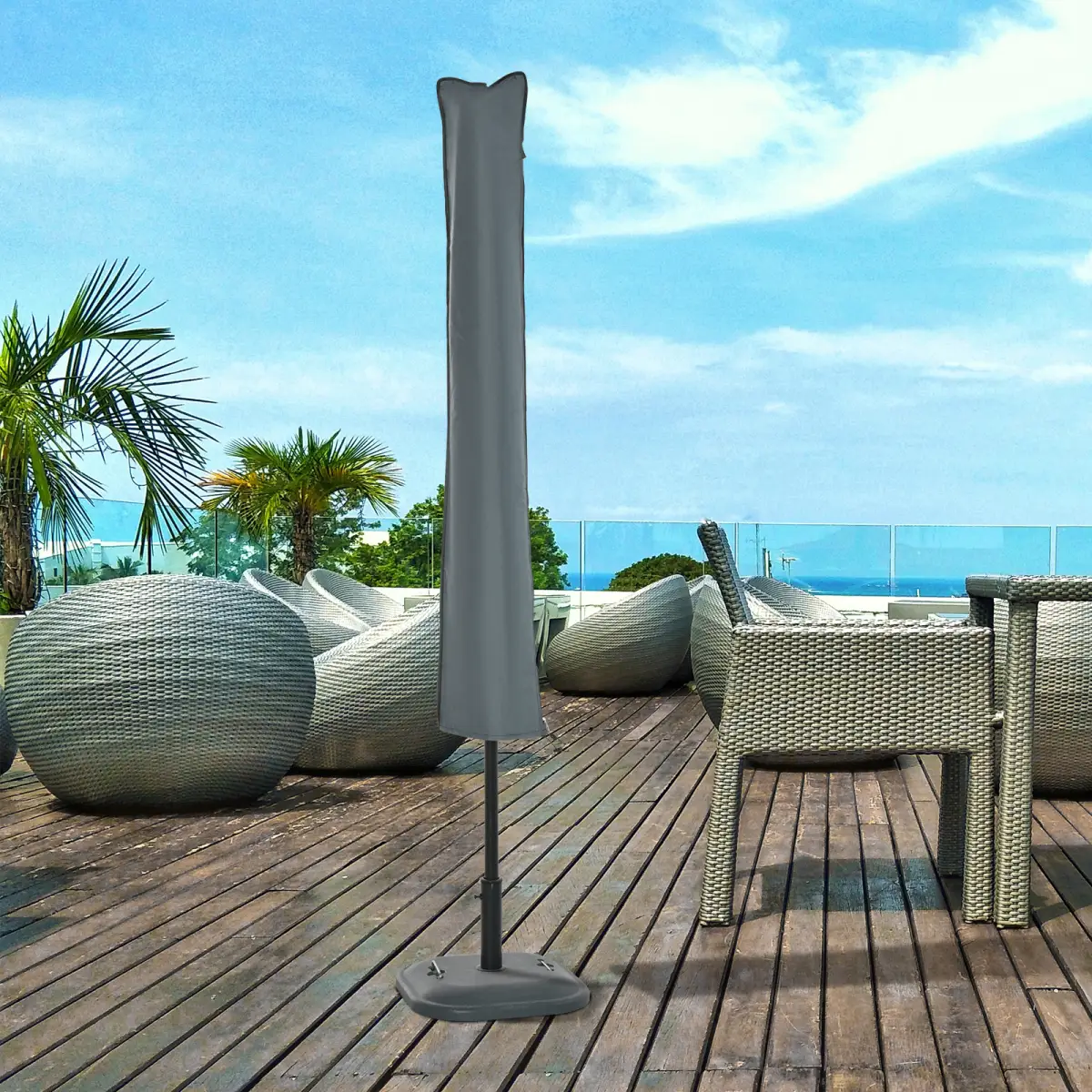
A few small details make a cover much nicer to live with. The most useful is a long side zip. It lets you slip the cover over a closed parasol without having to lift the whole thing over the top, and it means you can often leave the parasol standing in its base while you cover it. Trying to hood a tall parasol without a zip usually ends with a ladder and a bit of swearing.
Some covers come with a guiding rod or stick. You hook the cover onto the rod and use it to drop the fabric down over the canopy from ground level, which is a genuine help with anything tall. A drawstring or tie at the bottom then pulls the cover snug so the wind can't lift it off, and on cantilever covers you'll sometimes find wind straps doing the same job.
None of these are essential, but if you've ever wrestled a cover onto a 3m parasol in a breeze, you'll appreciate why they're worth having.
Colour and where it sits
There isn't much to overthink here. Covers are kept deliberately plain, usually in greys, blacks and quiet greens that sit unnoticed in a garden over winter. The point of a cover is to disappear, not to make a statement, so a neutral shade that blends with fencing or paving is the sensible pick.
A quick check before you buy
Run through this and you'll avoid the common mistakes:
- Measured the closed height and folded width, and checked them against the cover's dimensions
- Picked a shape that matches your parasol, with a banana or cantilever cover for offset models
- Chosen a coated, waterproof fabric rather than something only water-resistant
- Looked for a side zip, and a guiding rod or drawstring if your parasol is tall
Looking after it through winter
A cover does a good job all season for overnight and between-use protection, but it earns its keep over winter. Wherever you can, bring the parasol indoors or into a shed for the coldest, wettest months, stored closed and covered. If it has to stay outside, a snug cover is the next best thing, just make sure it can drain and dry rather than trapping water against the fabric.
If you're protecting more than the parasol, it's worth looking at the wider range of garden furniture covers at the same time, and a heavier parasol base is worth a thought if yours has ever felt unsteady in a gust. You can see the full selection of parasol covers here, or browse the garden parasols themselves if you're still deciding on the parasol first.
Free delivery applies on every order to UK mainland addresses, dispatched within 3 to 5 working days, with no hidden fees. Covers arrive ready to use, so the next time rain is forecast, yours can be on before the first drops land.